


What Is Production Planning and Scheduling

Production planning and scheduling is the process of creating a detailed execution plan and manufacturing roadmap that shows the required resources and the milestones needed to complete a manufacturing order on time.
Planning and scheduling are similar in nature, given that they go handProduction Planning vs Production Scheduling
Before we can start explaining what exactly the differences are between production planning and scheduling, let’s first go through the definitions of each.
Production Planning
Planning is the process of determining which products to produce, how much to produce, and when to produce them, from the procurement of raw materials to the delivery of finished products.
The main objective of planning is to ensure that capacity and demand are aligned before production begins. Planning helps you and your teams stay organized to meet customer demand while minimizing costs to start and finish your production runs.
To get started, you’ll need to figure out what’s needed:
- Capacity — Forecasting demand for products to predict how much you’ll need to make, and if you have the necessary machinery, workers, and equipment available to meet that demand, as well as factoring in budget.
- Materials — Using the same forecast, you can check if you have enough raw materials available, and if not, will they become available based on your plan.
- Resources — If you now have the capacity and materials to meet demand, you can proceed to assign tasks and operations.
Depending on the size of your business and the scale of your manufacturing, a production manager is typically responsible for developing and managing production plans and working closely with all necessary workers, contractors, and departments to implement them. Another factor that will dictate how your plan is created and ultimately looks is whether you make to order or make to stock. Once all information is determined, your plan will clarify for you and your collaborators exactly what is expected for a specific run.
Production Scheduling
Production or manufacturing scheduling is the process of determining the time and dates by which a plan must be executed to meet production goals or to deliver a product to a client at a pre-agreed point in time.
Scheduling will help your organization identify the milestones they need to reach and when, helping teams understand who is doing what and when. At this stage, you’ll be deciding how the plan is being implemented and actively monitoring progress to ensure everything is running smoothly.
To get started, you’ll need to figure out what’s needed:
- Tasks — Assigning and prioritizing tasks based on customer demand, order size, and production deadlines helps you and your team complete critical tasks first.
- Sequencing — Identifying and establishing dependencies to ensure your manufacturing route is followed correctly.
- Timelines — Adjusting timelines after production begins in response to feedback from your team or production scheduling software to minimize downtime and maximize efficiency.
If you’re creating a schedule for all your manufacturing orders, you can refer to it as a Master Production Schedule (MPS), as it is an entire overview of your production activities.
With your schedule in hand, you can better track the progress of your tasks to ensure everything is on schedule. If something takes longer than initially anticipated, you can easily make adjustments to the schedule and start to investigate why a delay occurred to avoid the same issues in the future.
The Key Differences Between Production Planning and Scheduling
The production plan comprises all the key components of manufacturing, and production scheduling is the mechanism that binds them into a clear, actionable document that your organization can use and follow.
In production planning and scheduling, planning is the strategic focus of manufacturing, focused on long-term goals. Scheduling is the tactical aspect, focusing on short-term execution to achieve goals set in the plan.
Here is how they differ when you’re formulating your production plan and scheduling:
- Scope — Planning looks at your broader strategic goals and factors in long-term demand and resource availability. Scheduling looks at detailed, short-term operational steps.
- Objectives — Planning ensures your production is aligned with business goals and demand. Scheduling ensures that the necessary tasks are being completed efficiently to reach that alignment.
- Timeframe — Planning covers extended periods, typically weeks, months, or even years. Scheduling covers shorter periods, from days to weeks.
- Level of detail — Planning considers the big picture, such as overall information, available resources, and general predictions. Scheduling is all about the details, such as specific tasks, exact times, and the people or tools needed.
To take it away from manufacturing for a second, chess is a fantastic analogy for production planning and scheduling.
In chess, you have strategy (the plan) and tactics (the schedule). A long-term goal is to develop your pawns and achieve control of the center of the board. But to achieve this goal, you will need to perform maneuvers and respond to threats.
So, let’s say we have a woodworking manufacturer with a strategy to produce 1000 chessboards in one month. A tactic would be to produce 250 boards a week. Unfortunately, one week they fall short of their target by 123 units.
Given their schedule, they can respond to this issue by outsourcing some production to another manufacturer, ensuring that the following week they can meet 377 and maintain their 1000 a month target.
The bottom line of it all, production planning and scheduling, is the backbone of effective production management.
What Are the 5 Steps of Production Planning?
To create a successful production plan, you will need to focus on building it around five different stages.
Each of these steps supports the others, so if you make a mistake in your planning at any point, it will cascade through the following steps and cause chaos on your shop floor. Here are the five steps you can follow when working on your production planning and scheduling:
1. Demand Forecasting
You need to know how much product to produce, and your demand forecast will help you plan accordingly.
Once you know your demand, you’ll be able to better anticipate:
- How much capacity to reserve
- How many materials to order
- How tight the schedule needs to be
If you incorrectly calculate how much you actually need to produce, it will inevitably lead to overstocking or stockouts.
2. Resource and Capacity Assessment
Once you know what you need to fulfill demand, the next step is to figure out if it's actually possible to produce all the stuff that you need.
You’ll do this by answering the following questions:
- Do you have the machines, labor, and materials to hit that number?
- Does the plan need to shrink?
- Does capacity need to expand first?
By answering these questions, you’ll know whether the plan can continue or if you need to take a step back and set a more realistic target.
3. Production Scheduling
Your plan is all confirmed, and now it’s time to think of deadlines and production sequencing:
- What runs first
- What depends on what
- Who's assigned to it
- By when it needs to be done
At this stage, you’re taking your strategy and converting it into a series of tactics for people to follow to achieve your goals.
4. Execution and Dispatching
With the plan and schedule determined, we can make a start on:
- Releasing work orders
- Committing raw materials to production
- Allowing operators to start on production steps based on sequencing
5. Monitoring and Control
It’s important to ensure that everything is going according to plan by tracking actual progress against the schedule so deviations get caught while there's still time to act, problems such as:
- A late supplier delivery
- A machine going down
- A task running longer than planned
At this stage, if a problem does arise, you essentially need to go back to steps 2 and 3 and begin the production planning and scheduling process again.
And the solution will come from implementing measures such as a revised capacity call or a resequenced schedule, which is one of the reasons why the five steps function as a cycle, not a one-way process.
What Are the 5 P's of Production?
Where the five steps describe the sequence of production planning, the 5 P's describe the inputs that sequence has to account for at every stage:
- Product — What's actually being made, since manufacturing only has a purpose once there's a product tied to market demand
- Plant — The facility, layout, and equipment production runs on (we’ll cover this in more detail under Capacity Planning)
- Processes — the specific methods and techniques used to turn inputs into the finished product.
- Program — the timetable that governs when each step happens, which is what Production Scheduling puts into practice.
- People — the workforce carrying out the plan, addressed further under Resource Allocation.
Why Is Production Planning and Scheduling Important?
"Give me six hours to chop down a tree, and I will spend the first four sharpening the axe." — Abraham Lincoln
A president from the 1860s understood the importance of preparing to take on a task, and even over 150 years later, it's still as important to plan and plan again before committing to production.
Without a forecast to plan against, a business either overstocks materials and ties up cash in the warehouse, or runs short at the worst possible moment and scrambles to source substitutes at a premium.
Without a schedule, work gets assigned reactively, which leaves some machines and workers idle while others are stretched thin, and turns every missed step into a fire that the whole team has to drop everything to fight.
But the higher cost shows up with customers.
Orders without a clear production runway slip past their promised delivery date, and a pattern of missed deadlines is what pushes a client to a competitor who can hit theirs.
None of this is recoverable after the fact. By the time a shortage or delay is visible on the shop floor, the plan needs to account for it weeks earlier to prevent the chaos before it starts.
The Key Components of Production Planning and Scheduling
.jpeg)
Now that you know exactly what production planning and scheduling are, along with their nuances (and even a little bit of chess knowledge, too), the next part is to delve into the different components that come together to form your plans and schedules.
1. Forecasting Demand
Demand forecasting is the process of determining what the demand for products will be based on:
- Market and manufacturing trends
- Historical data
- Customer insights
- Technological advancements
With your demand accurately forecasted, you’ll be able to understand how many products you need to produce over a given period, helping you mitigate the risks of under- and overproduction. Without this information, you will either increase customer dissatisfaction by being unable to sell products or clog your warehouse with excess inventory, both of which will reduce your revenue.
2. Capacity Planning
Capacity planning in manufacturing allows you to assess if your current setup is capable of delivering the necessary quantity of products with your currently available resources:
- Labor
- Equipment
- Time
Having this information calculated will help you determine what output you can produce with existing resources, allowing you to determine whether to begin production or address constraints in your production lines, prevent bottlenecks, and meet your organization’s production goals.
For example, a production line running three machines across 8-hour shifts has 24 machine-hours of capacity per day.
If a new order requires 30 machine-hours to complete on schedule, that gap is a bottleneck you need to solve before the order even starts, by implementing:
- Overtime
- Extra shifts
- Outsourcing
3. Material and Procurement Planning
Without the right amount of items to help you complete an order, your production is doomed to fail.
Material planning and procurement help you identify the quantities and raw materials needed to meet demand. If you’re currently understocked, procurement ensures the purchase of the required raw materials, and your planning and scheduling will account for the lead times for delivery. Having this done properly, preferably using MRP software, minimizes the risk of production delays from stockouts.
For example, if a key raw material has a 2-week lead time, your production schedule needs to start at least 2 weeks before your "ideal" start date — otherwise, you're waiting on materials before the first task can even begin.
Some external factors to consider at this point are your suppliers.
You’ll want to establish strong relationships with your suppliers to strengthen your supply chain while keeping your procurement costs low. This will mean:
- Coordinating delivery schedules
- Negotiating pricing
- Maintaining consistent quality standards
And it never hurts to have a Plan B in case there are delays with your supplies.
4. Production Scheduling
Now we’re getting to the nitty-gritty.
We know the resources available to us and the constraints we face, and have developed a plan based on this information. Time to put it all into action with your scheduling. As already touched on heavily throughout the article, a thoroughly executed plan done right with great scheduling helps you:
- Streamline manufacturing processes
- Increase production efficiency
- Fulfill manufacturing and sales orders on time
5. Resource Allocation
You know how and when you’re going to make it, so it’s time to make sure those who are responsible for delivering on a task know they have work to do.
You can now assign your team members, machines, and workstations to specific tasks, in the order they must be completed. However, just because something is available doesn’t mean 100% of their focus should be dedicated to it. It’s not just a matter of assigning tasks — it’s making sure that your resources aren’t overworked.
6. Master Production Schedule
We briefly touched upon a master production schedule (MPS) earlier, but essentially, this is your comprehensive plan that details:
- What products to produce
- Their quantities
- Timelines
You will need to create this before starting any manufacturing, as it serves as a roadmap that integrates information on production goals, resources, timelines, and inventory into one source of truth. Having this ready will be essential for controlling and monitoring production progress, improving productivity, minimizing waste, and ensuring on-time completion.
7. Production Control and Monitoring
Once everything is underway, it’s time to make sure everything stays on track, and this is where production control and monitoring come in.
It allows manufacturers to detect any deviations, inefficiencies, or issues in the workflow and address them as soon as possible. Regular real-time monitoring and control ensure the efficiency of production planning processes and contribute to timely product delivery.
At this stage, you’re on the lookout for any issues, with the goal of addressing them before they spiral into a bigger problem, such as:
- Product or manufacturing deviations
- Inefficiencies along your routes
- Issues in your manufacturing processes
For this component to work properly in your production planning and scheduling, it relies heavily on real-time data collection and analysis. This could be in the form of line managers or workers self-reporting via offline methods or shop floor control software. However you collect this information, having it will help you take corrective action immediately when a problem arises.
Methods of Production Planning and Scheduling
Beyond deciding what to produce and when, manufacturers also have to decide how to build the schedule itself.
Several established methods exist, and none of them is universally "best" — the right choice depends on how stable your demand is, how much visibility you have into real-time resource availability, and whether your priority is meeting a due date or keeping resources fully utilized. Many manufacturers combine methods rather than relying on just one.
Time Direction Methods
Forward and backward scheduling differ in which end of the timeline drives the plan.
Forward scheduling starts from the earliest possible start date and moves forward, completing each step as soon as resource availability allows. The completion date is whatever falls out the other end once every step is scheduled, which makes this method useful when demand is stable, and resource utilization matters more than hitting an exact delivery date.
Its downside is that a delay anywhere in the sequence has no built-in buffer, so bottlenecks can push the finish date later with little warning.
Backward scheduling starts from the due date and works backward to determine the latest safe start date for each step.
Because the due date is fixed and everything else is calculated around it, this method is the better fit when on-time delivery is the priority — particularly in make-to-order environments where finishing early just means paying to store finished goods longer than necessary. It requires accurate, up-to-date information about every resource involved, since there's little room for error.
Capacity Approaches
Infinite and finite scheduling differ in whether the plan accounts for real-world resource limits.
Infinite scheduling builds the plan as though labor, machines, and materials are available without limit, focused on meeting demand and deadlines rather than checking those numbers against what's actually on hand. This makes it a practical tool for long-term baseline planning and forecasting the capacity needed to grow, but it isn't built to respond to disruptions, since it never checks real constraints in the first place.
Finite scheduling builds the plan around real-time constraints on equipment, space, staff, and materials, making it the stronger choice when filling a specific, limited order or when the production process has just been disrupted, and the plan needs to reflect what's actually available right now.
That same real-time dependency is its main requirement, as the method only works if the underlying data on resource availability is accurate and up to date.
Workflow Sequences
Parallel, sequential, and dynamic scheduling describe how tasks move relative to each other during execution.
Parallel scheduling runs multiple tasks simultaneously across independent stations or machines, thereby shortening overall lead times and working well for complex products whose components can be produced independently of one another.
Sequential scheduling runs tasks one after another in a fixed order, where each step waits for the previous one to finish. This is the standard flow on most assembly lines, and its simplicity makes it easy to control, but it also means that a slowdown at any single stage delays every stage that follows.
Dynamic scheduling continuously adjusts the plan in real time in response to events such as a machine breakdown, a supplier delay, or an urgent order that needs to jump the queue. Because it depends on the schedule updating itself as conditions change, it typically requires dedicated advanced planning and scheduling (APS) software rather than a static plan someone updates by hand.
Just-in-Time (JIT) Scheduling
JIT scheduling ties production to actual demand rather than a forecast, so products are manufactured only when an order calls for them, and materials are ordered to arrive in the quantity and at the time production actually needs them. This keeps inventory and storage costs low, but it also leaves very little buffer for a late supplier delivery or an unexpected spike in demand, since the whole method depends on materials showing up exactly when planned.
9 KPIs for Assessing Your Production Planning and Scheduling
Okay, you have all the information that you need to start seriously upping your planning and scheduling skills.
But, how do you know if what you have planned is actually moving the needle in the right direction? Here are some KPIs you can use to get you started on analyzing if your planning and scheduling are all coming together.
1. Inventory Turnover
Inventory turnover is the measurement of how quickly your inventory is sold and restocked within a specific time frame.
If your inventory turnover is high, this is a good sign that your planning and management are on point. However, if it is low, this indicates a problem, such as overstocking or insufficient demand. Figuring out your turnover rate will provide you with valuable insights into how efficient your production planning is. To calculate it, you can use the following formula:
Inventory Turnover = Cost of Goods Sold (COGS) / Average Inventory Value
2. Lead Time
Lead time represents just how long it takes your business to complete a production cycle from start to finish.
Ironically, you will need this information during your production planning and scheduling phase, but you’ll also need to monitor it after a production run. Tracking it will help you identify bottlenecks on your shop floor and enhance factory efficiency, thereby improving your order fulfillment rates. In its simplest form, you calculate your lead time by measuring the time from when production begins to when your final products are ready for delivery.
However, for more accurate lead times, you should also include the tracking of:
- Sourcing materials
- Quality control
- Packaging
3. Cycle Time
Cycle time is similar to lead time, but it is more granular, focusing on a single unit rather than a batch or the output of a production or assembly line.
With the cycle time, you will focus on the shop floor to identify productivity issues and optimize your production processes. Once again, this is a straightforward calculation. Track the time production started and the time a specific unit is finalized.
This is a fairly common feature in most manufacturing software, often referred to as planned production vs. actual hours.
Software can help you track how long it took to produce a batch or a specific item, as long as it can pull from historical data, or you define the hours it will take to make something based on your plans. You’ll end up with one of three variations:
- Positive: Actual hours < Planned hours
- Negative: Actual hours > Planned hours
- Neutral: Actual hours = Planned hours
Positive means that everything is super efficient, or you’ve overestimated production times. A negative finding indicates underestimation, inefficiencies, or issues. Neutral, just like Goldilocks and Baby Bear's porridge, means everything is just right.
Unless you want to scale your operations, your current set-up leaves no room to take on any more.
4. Capacity Utilization
Capacity utilization monitors how much of your resources are being utilized as a percentage.
Having this information in hand will help you understand the efficiency of your production lines and help you make adjustments to improve output. The higher your percentage, the more your current capacity is being utilized. If it’s lower, that indicates machines are idle, and workers have nothing to do.
This can be done at the macro level by analyzing capacity utilization, or at the departmental or workstation level. You can use the following formula to calculate your percentage:
Capacity Utilization = (Actual Output / Potential Output) * 100
A line producing 850 units against a potential output of 1,000 units has a capacity utilization of 85% — within the 80–90% target range.
Rule of thumb: There is such a thing as too high. 100% capacity isn’t a good thing, and you should always leave some wiggle room in case you need to pivot priorities at any given point. Determine the best benchmark for your business.
However, as a placeholder, anywhere between 80% and 90% is a reasonable target.
5. Employee Utilization
Similar to the previous KPI, employee utilization focuses on ensuring that you don’t overwork your workforce.
Here you will be looking into:
- Employees' available work hours
- Billable hours
- Non-billable
It will help improve profitability, but you can consider this more of an HR KPI, since you’ll be using it to optimize staffing, forecast capacity, and prevent burnout by balancing workloads.
6. On-Time Delivery
Similar to lead and cycle time, this KPI will help you determine whether you’re fulfilling orders within the promised timeframes for your clients and customers.
It’s primarily concerned with your supply chain, monitoring the time required for a delivery from your warehouse to reach its final destination and the time required for a supplier to send a shipment to you. This will help you identify if delays are occurring during:
- Shipping
- Manufacturing
- Delivery
7. Stockout Rate
Stockout rates will help you fine-tune your inventory levels to ensure that your warehouses or bin locations aren’t bare when it comes time to make or sell something.
You can calculate your stockout rate by dividing the number of stockout events by the total number of sales orders within a given timeframe, then multiplying by 100 to obtain the rate as a percentage. Here it is as a formula:
Stockout Rate = (Number of Stockouts / Total Sales Orders) * 100
12 stockouts against 400 sales orders in a month gives a stockout rate of 3%.
It probably goes without saying how important it is to track this, but ultimately, you could avoid stockouts altogether by implementing inventory management software in your business.
8. Order Fulfillment Time
Your order fulfillment time tracks the points when an order is:
- Processed
- Manufactured
- Delivered
Starting as soon as an order is placed by a client or customer, knowing this time frame is important for meeting customer expectations and minimizing delays. To calculate it, you will begin by documenting the order’s receipt through delivery to the final destination. However, to accurately determine how long it takes, you will also need to time how long it takes to produce the product.
The order fulfillment time formula:
Order Fulfillment Time = Order Processing Time + Manufacturing Time + Delivery Time.
9. Work-in-Progress (WIP)
Let’s say expectations aren’t aligning with your production planning and scheduling, and investigating your WIP orders could help you identify areas for improvement and ensure a smooth workflow.
Looking into your WIP will help you understand how much of your stock is currently committed to production, and determine inefficiencies, potential waste, or bottlenecks in your production process that need to be addressed. To make this calculation, you will need to check the value of all the raw materials, semi-finished goods, and unfinished products that are somewhere on the shop floor.
Work-in-progress formula:
WIP = Beginning WIP + Manufacturing Costs – Cost of Goods Manufactured (COGM)
Taking Production Planning and Scheduling to the Next Level
When your business is just starting out, you can probably manage with whiteboards, clipboards, and spreadsheets.
For micro-manufacturers or businesses with fewer than 10 stakeholders, this will likely be an optimal solution. However, as more orders come in and the complexity of your operations increases, manual production planning and scheduling processes fall apart:
- Orders pile up
- Delivery windows shrink
- Paperwork becomes guesswork
This is the time to consider implementing production planning and scheduling software (PPS) in your business.
This will allow your teams to move away from reactive firefighting and figure out ways to make production even leaner as you’re free from trying to fix the problems caused by following incorrect data.
PPS software works by pulling all your production data into one place in real time, such as:
- Sales demand
- Manufacturing orders
- Available capacity
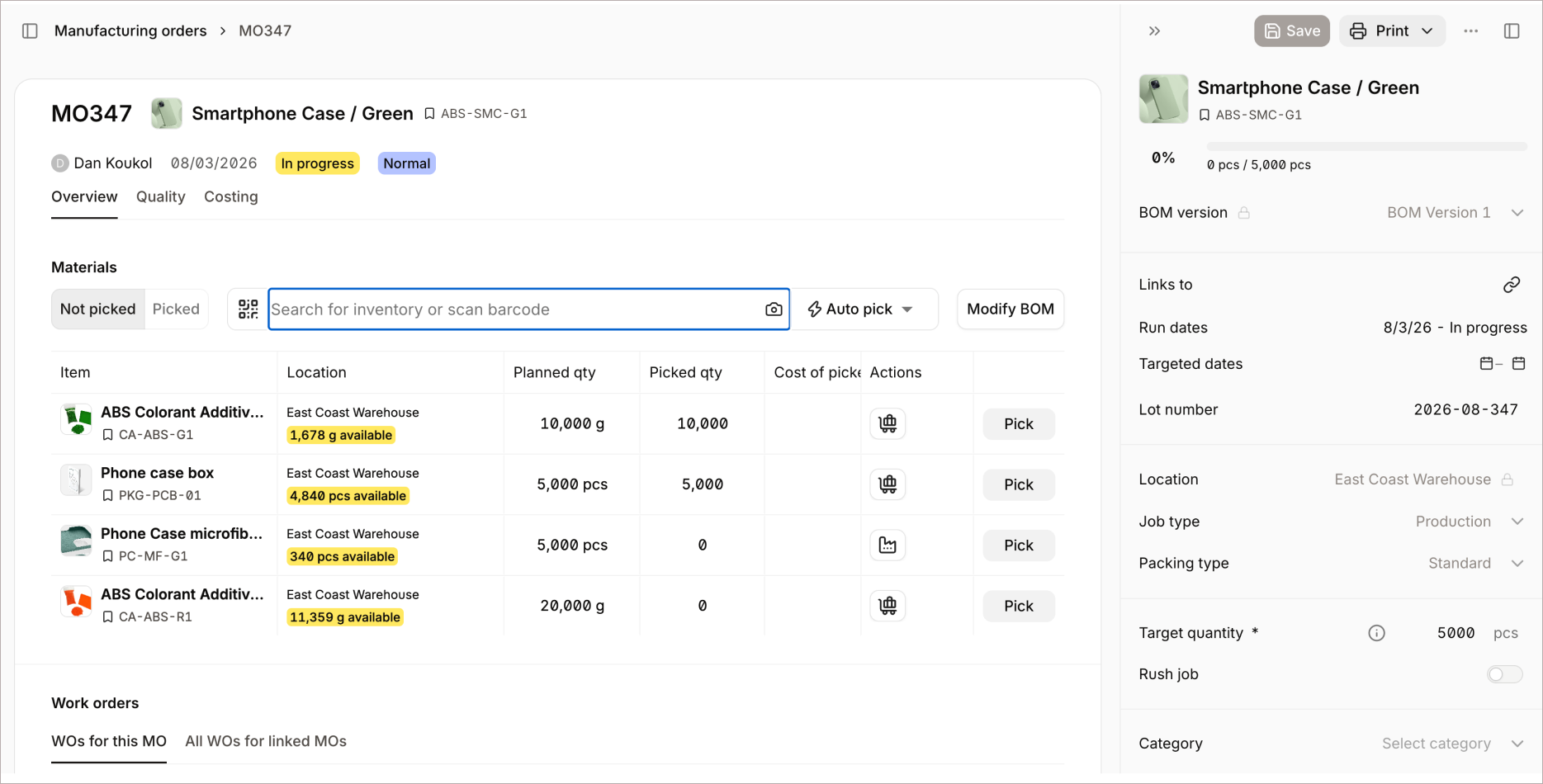
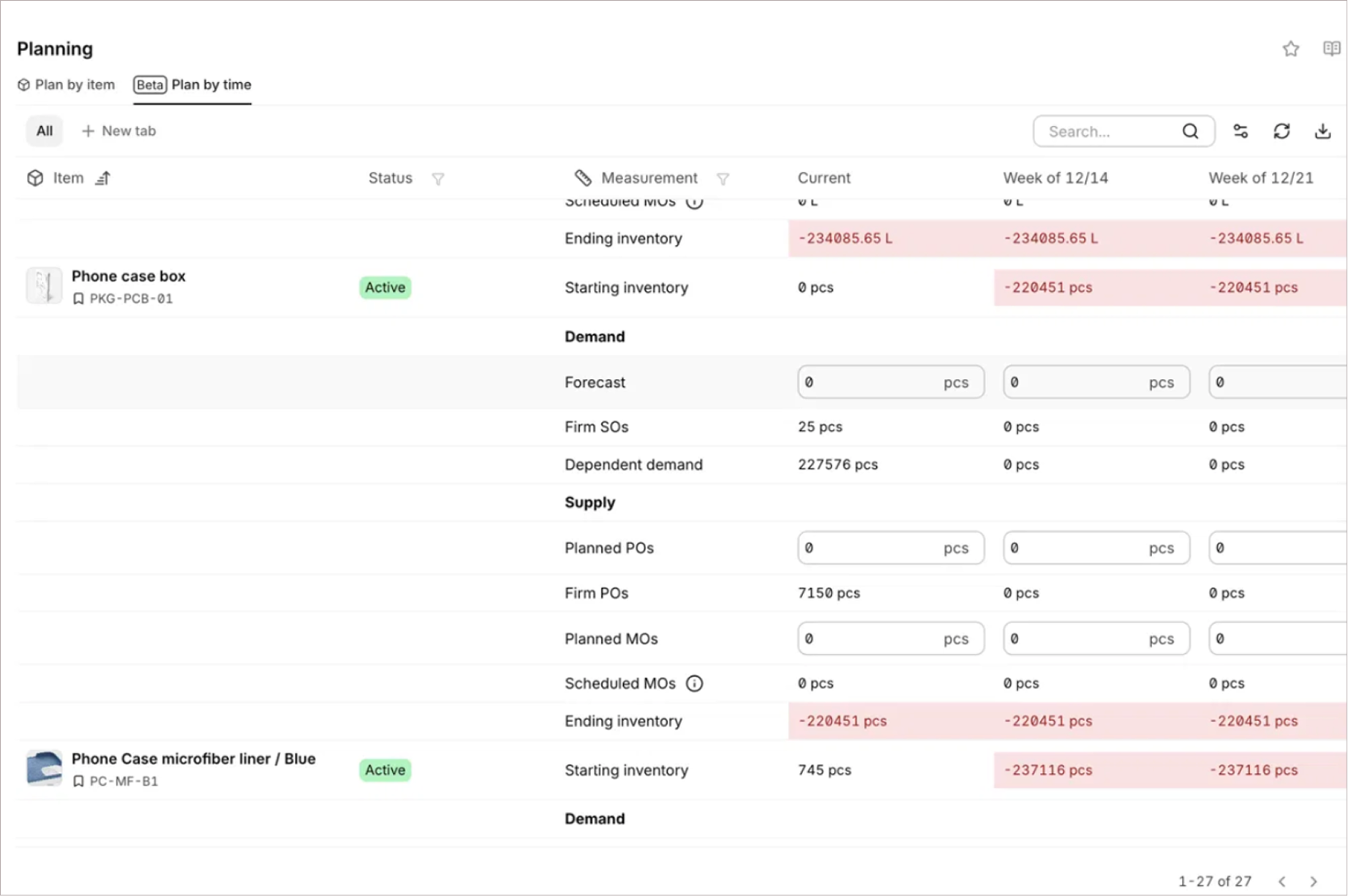
Enabling you to identify bottlenecks early and make realistic trade-offs. For example, tools such as Sutton bring your incoming demand and available capacity into a single planning view, showing what needs to be produced next against what you currently have on hand.
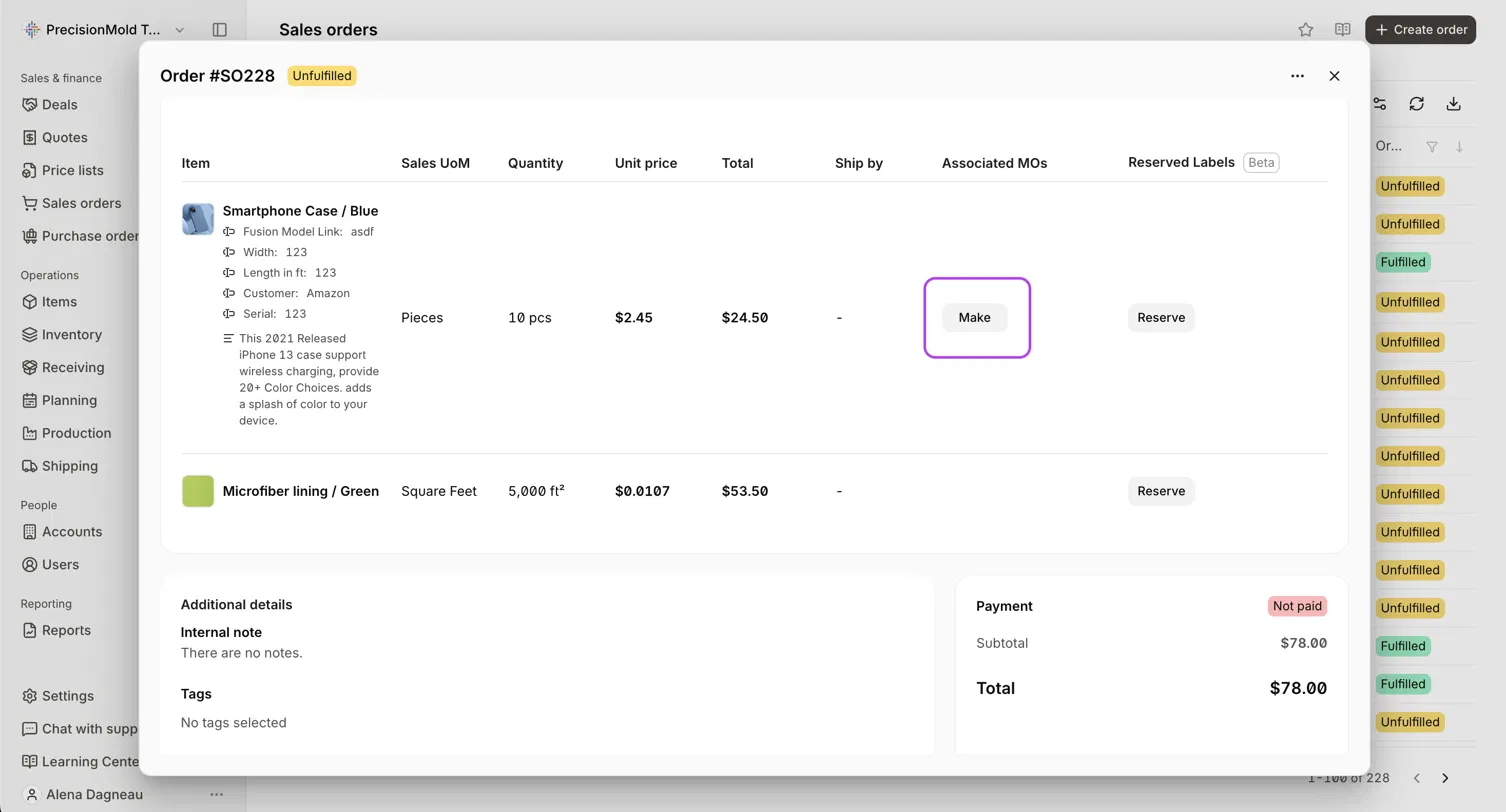
When a sales order comes in, you can create the manufacturing order directly from that order with a single click, pulling in the required components and pricing automatically rather than rebuilding the job from scratch.
That manufacturing order carries its own routing, breaking the job into the individual work orders needed to complete it. For example, in the case of a chocolate bar production run:
- Liquefying
- Tempering
- Molding
- Cooling
- Wrapping
Each work order shows its target quantity and progress, so you always know what's next and what's left to finish.
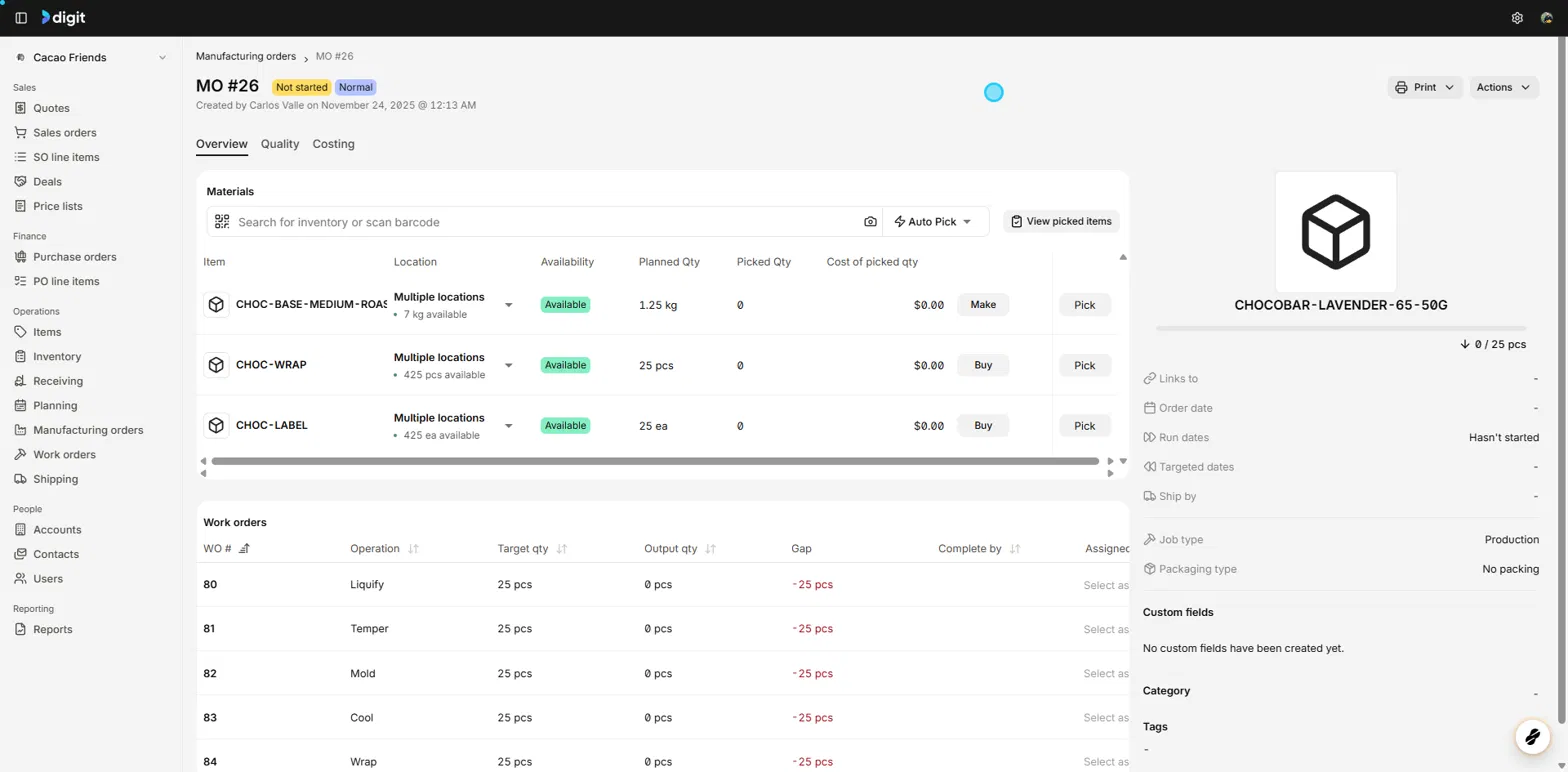
Should a material run short or a delivery slip, Sutton flags the shortfall against your planned dates so you can reprioritize orders and routes before it holds up the rest of the schedule.
Ultimately, PPS software eliminates the uncertainty of manually updating your plans and schedules, saving time, reducing errors, and improving your profit margins.
Want to see for yourself? Book a call with one of our manufacturing experts to see how easy it is to automate production planning and scheduling.
.jpg)