



What Is a Food Safety Audit?

A food safety audit basically means an evaluation of how a business handles perishable inventory, and its operations surrounding production, to understand if a company is conforming to:
- Food safety laws
- Standards
- Procedures
A food safety audit usually involves inspecting the storage, production, and shipping areas to ensure that all necessary steps are being taken to prevent contamination and protect consumers from foodborne illness.
These food safety audits can be performed either in-house or externally by a third party (which we will cover later in the article), but the goal of the audit is to produce a report highlighting the areas in which food safety compliance is being met and the areas that need improvement with the implementation of a food safety management strategy.
The focus areas of a food safety audit depend on the type of business and its manufacturing processes.
Take, for example, a food processing plant that handles raw meat. This type of company would need to be audited on how it handles and stores raw materials, as well as its procedures for sanitation and cleaning of equipment and facilities. And because it manages raw meat and carries the risk of contamination, it needs to have its HACCP plan reviewed, which will cover:
- Hazard analysis
- Critical control points
- Corrective actions
Then, to compare that with another food and beverage business, we might consider a company that provides catering services.
Even though both handle food products, they will be audited slightly differently. A catering company will be audited on how it handles food, transports goods, and maintains staff hygiene practices.
Regardless of the differences in how the company handles and what it does to any food products, all food safety audits are here to serve several objectives:
- Certification against specific food safety standards
- Assessment of premises condition and overall business performance
- Verification of legal compliance
- Investigation in response to a complaint
- Fulfillment of a regulatory requirement
- Response to a food supplier's request
- Support for broader business objectives
So, now you know what is a food safety audit, let's try to take a bite out of understanding this industry in a little more detail.
The Importance of Food Safety Audits
.jpg)
The last section already danced around this, but we're happy to go through it in more detail.
Besides the risk and implications for public safety if you fail to do your own food safety audits, the other benefits that come from taking the time to incorporate this practice into your business are:
- Verification that you’re legally compliant
- Protection for your brand’s reputation
- An early warning detection system if something is wrong
But here are other reasons why it's good to understand a food safety audit's importance.
Protecting Public Health
Food safety audits are a vital tool for catching dangerous pathogens before they reach the marketplace, including:
- Salmonella
- Listeria
- E. coli
These audits help you prevent potential outbreaks by giving you a framework to carefully review risk points (cold storage temperatures, cooking times, and surface sanitation) and prevent cross-contamination before it occurs.
Ensuring Compliance and Readiness
Again, the food and beverage industry is heavily regulated, and food safety audits and reports are going to help you demonstrate that your business meets regulatory requirements from:
- FDA
- Local health departments
- Frameworks like HACCP, ISO 22000, or GFSI
If you're not doing audits and an inspector comes to visit your facility, you're exposing yourself to fines and penalties that could have otherwise been avoided with due diligence.
Protecting Brand Value
Even though food recalls are there to help protect people and demonstrate that you're doing your part to accept responsibility, they still carry a huge chance of damaging your reputation with customers.
Ultimately, the best course of action is to avoid them altogether through food safety audits, which help you avoid the costs of recalls and the legal exposure that comes with them. By conducting audits, you can signal to customers, suppliers, and retail partners that you take safety seriously and can back it up with your audit reports if needed.
Government and Consumer Expectations
Food safety regulations range from the U.S. Food Safety Modernization Act to international standards like:
There are many regulations and laws that must be followed worldwide when selling food, with almost all of them requiring proof of real-time, end-to-end traceability. A food safety audit is going to help you analyze what requirements you need to fulfill and how compliant your operations are with the particular market in which you sell your goods.
Then there are consumers who have grown accustomed to buying foods based on diet trends or on whether they come with certain certifications proving they're safe for consumption. By failing to perform an audit, a business risks turning what would have been a small internal issue into a full public relations crisis.
The Different Types of Food Safety Audits
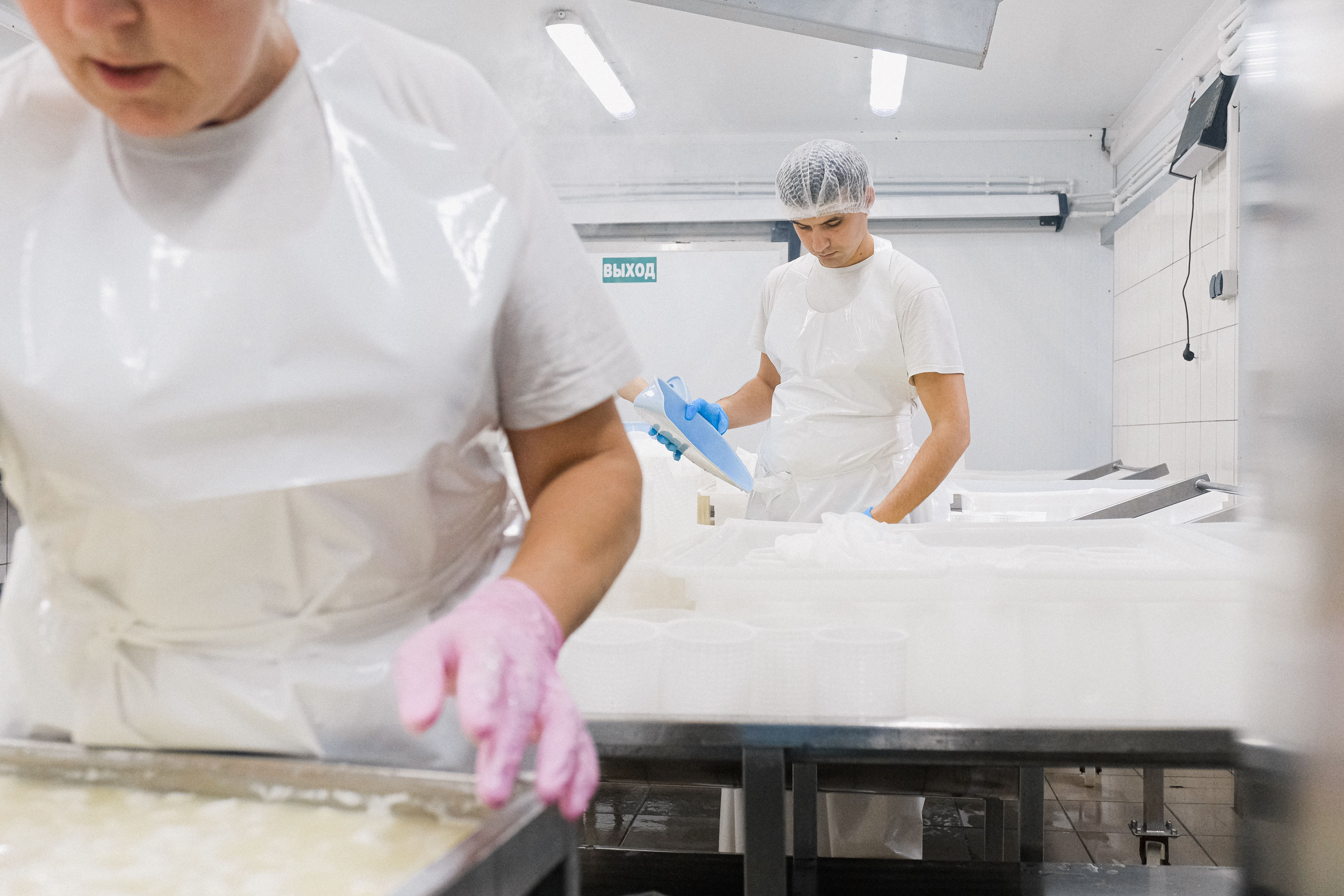
Earlier in the article, we mentioned that food safety audits can be conducted either internally or externally.
However, the types of audits you could be doing as a food producer extend beyond that and can be grouped into four categories:
- Internal audits conducted by a business's own staff
- Supplier audits conducted on external vendors
- Certification audits conducted by accredited third parties
- Regulatory audits conducted by government agencies
Let's explore each in more detail.
1. First-Party Audits
If you're not doing this one, it's the one you should absolutely start right now.
A first-party audit is an internal self-assessment conducted by the company's own staff, managers, or in-house auditors to evaluate the business's food safety compliance and systems.
Because they're done in-house and by the people who're already very familiar with your business's operations, these audits are cheaper and make it easier to identify actionable steps for improvement, as the auditor already knows how things should be done. If you want to perform your own internal audit, you would start by looking into things like:
- Food storage and temperature control
- Food preparation and cross-contamination prevention
- Sanitation and handwashing facilities
- Employee hygiene
- Facility layout
- Pest control
- HACCP compliance
If you can establish first-party food safety audits as a routine, they can be repurposed as a training tool and a way to uncover problem areas before a regulator or certifier finds them.
2. Second-Party Audits
A second-party audit is something you perform on your suppliers and vendors to ensure that the way they run their business is safe and compliant and that they're maintaining proper quality control.
Again, if you're not doing this, you should absolutely start doing it too, because ultimately, if a supplier sells you a bad batch of items, it's your brand and reputation on the line, not theirs. The purpose of conducting a food safety audit of your suppliers is to protect yourself from issues such as improper storage, transport, or handling at the supplier level and to help them identify and correct any weak spots.
Not only will this type of food safety audit protect you from issues on the supplier's end, but it will also strengthen your relationship with your working partner by improving efficiency and product quality across the food supply chain.
3. Certification (Third-Party) Audits: SQF, BRCGS, FSSC 22000
Third-party audits are conducted by independent, accredited certification bodies to verify compliance with recognized international standards — most commonly SQF, BRCGS, ISO 22000, and FSSC 22000, all of which fall under the GFSI umbrella.
These audits evaluate a company's entire food safety management system, including documentation, facilities, processes, and staff training. Certification is often rigorous to obtain, but it provides independent proof of a company's commitment to safety.
4. Regulatory Inspections: FDA and USDA
Regulatory audits are government-led inspections (conducted by agencies such as the FDA, USDA, or local health departments) to enforce legal food safety requirements.
Inspectors evaluate hygiene practices, temperature control, labeling, and documentation, and may interview staff to confirm protocols are followed in practice, not just on paper. Non-compliance can result in fines, mandatory recalls, or closure.
The Food Safety Audit Process
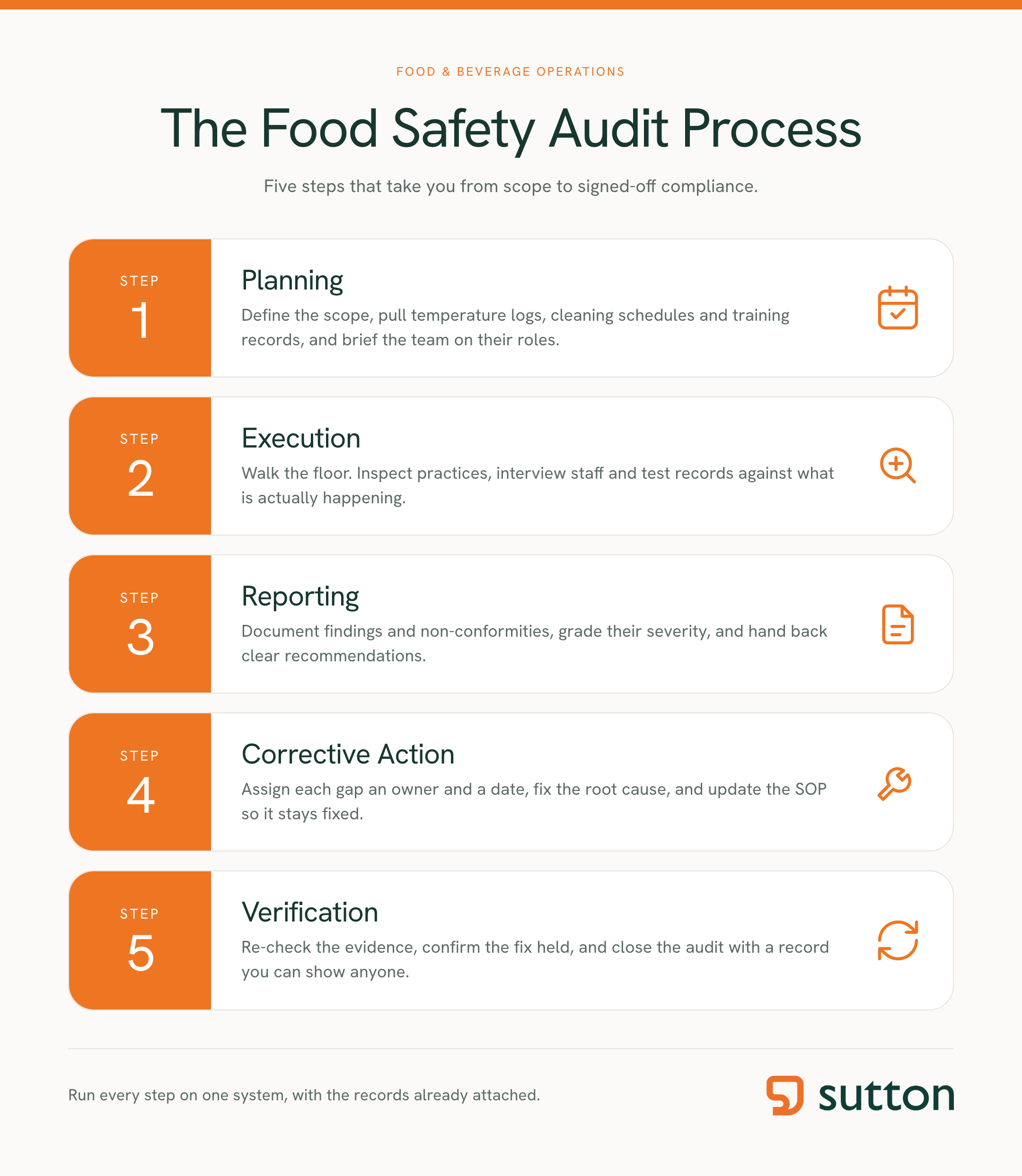
A comprehensive food safety audit follows five steps
- Planning
- Execution
- Reporting
- Corrective action
- Verification
If you're looking into implementing a food safety audit process in your business, here's how you can do it in five steps.
1. Planning
The auditor and business define the audit's scope (which areas, processes, and standards will be reviewed) and gather supporting records such as temperature logs, cleaning schedules, pest control reports, and training records.
Staff are notified in advance and assigned roles so expectations are clear before the audit begins.
2. Execution
The on-site portion typically opens with a desk audit — a document review confirming that SOPs, sanitation procedures, work instructions, policies, and records are complete and current.
To an auditor, proper documentation is the only acceptable evidence that a process is actually followed. From there, the auditor holds an opening meeting to outline the visit's purpose and methods, then gathers information through direct observation of food handling, receiving, and storage, a facility inspection covering equipment, cold chain management, and sanitation, and employee interviews to confirm staff understand their safety responsibilities.
3. Reporting
The auditor compares what was observed against the applicable food safety criteria and documents any non-conformities — gaps, violations, or failures to meet requirements.
Findings are presented to management in a closing meeting, with an opportunity to ask questions, before a full audit report is issued.
4. Corrective and Preventive Action
The business creates an action plan that assigns specific responsibilities and deadlines to address each identified gap, focusing on the underlying cause rather than applying a temporary patch.
5. Verification and Evaluation
The auditor or business confirms that corrective actions were completed and are working as intended.
The results feed back into the broader food safety program, supporting continuous improvement and readiness for the next audit.
The Most Common Audit Findings and Why They Recur
.png)
Certain issues surface again and again across food safety audits:
- Temperature control failures
- Poor hygiene and sanitation
- Pest management gaps
- Documentation shortfalls
- Storage or inventory mismanagement
Each tends to stem from a small, identifiable set of root causes, which is why the same findings keep reappearing audit after audit.
Improper Temperature Control
Food held outside safe temperature ranges raises the risk of foodborne illness and leads to spoilage and waste.
This usually traces back to inadequate refrigeration or heating, equipment malfunctions like broken thermostats, or inconsistent monitoring and recording. Businesses can get ahead of it by calibrating refrigeration and heating units regularly, enforcing strict temperature recording protocols, and training staff on proper temperature management.
Poor Hygiene and Sanitation
This covers both individual lapses (inconsistent handwashing, missing protective clothing) and organizational ones, like food contact surfaces that are wiped rather than properly washed and sanitized, or general kitchen areas (surfaces, equipment, floors, walls) that fall below standard.
The root cause is usually insufficient training combined with weak enforcement of hygiene policies, sometimes compounded by facilities that lack adequate handwashing stations or sanitation equipment. Fixing it requires regular hygiene training, properly equipped facilities, a documented cleaning protocol for food-contact surfaces after each use, and routine inspections to confirm the protocol is actually followed.
Inadequate Pest Control
Signs of pests are a recurring finding, usually driven by poor sanitation, structural gaps in walls or floors, or an ineffective pest control program.
Hard-to-reach areas like behind appliances and under sinks are the most commonly overlooked. Addressing it means comprehensive cleaning protocols that include those hard-to-reach spots, staff training on recognizing pest activity, periodic facility inspections for structural vulnerabilities, and an integrated pest management program run with a qualified provider.
Documentation and Traceability Gaps
Missing or incomplete records for incoming raw materials, such as the following, undermine an auditor's ability to verify compliance and can trigger regulatory penalties:
- Temperature logs
- Cleaning schedules
- Training records
- Traceability data
This often comes down to documentation being treated as a burden, especially in smaller operations, or a lack of resources and systems to manage records properly.
Digital document control systems, staff training on record-keeping standards, and regular internal reviews of documentation against current regulations all help close this gap.
Storage and Inventory Mismanagement
Improperly stored or expired stock raises contamination risk and drives food waste, typically caused by:
- Weak inventory systems
- Poor stock rotation
- Inadequate staff training on storage procedures
Common symptoms in these problem areas include products held past their expiry dates, cross-contamination from raw and cooked foods stored together, and irregular stock counts.
The fix is an FEFO-based inventory system with real-time tracking and expiry alerts, clear storage guidelines that separate raw and cooked items, and regular physical inventory checks paired with staff training.
How to Prepare for a Food Safety Audit
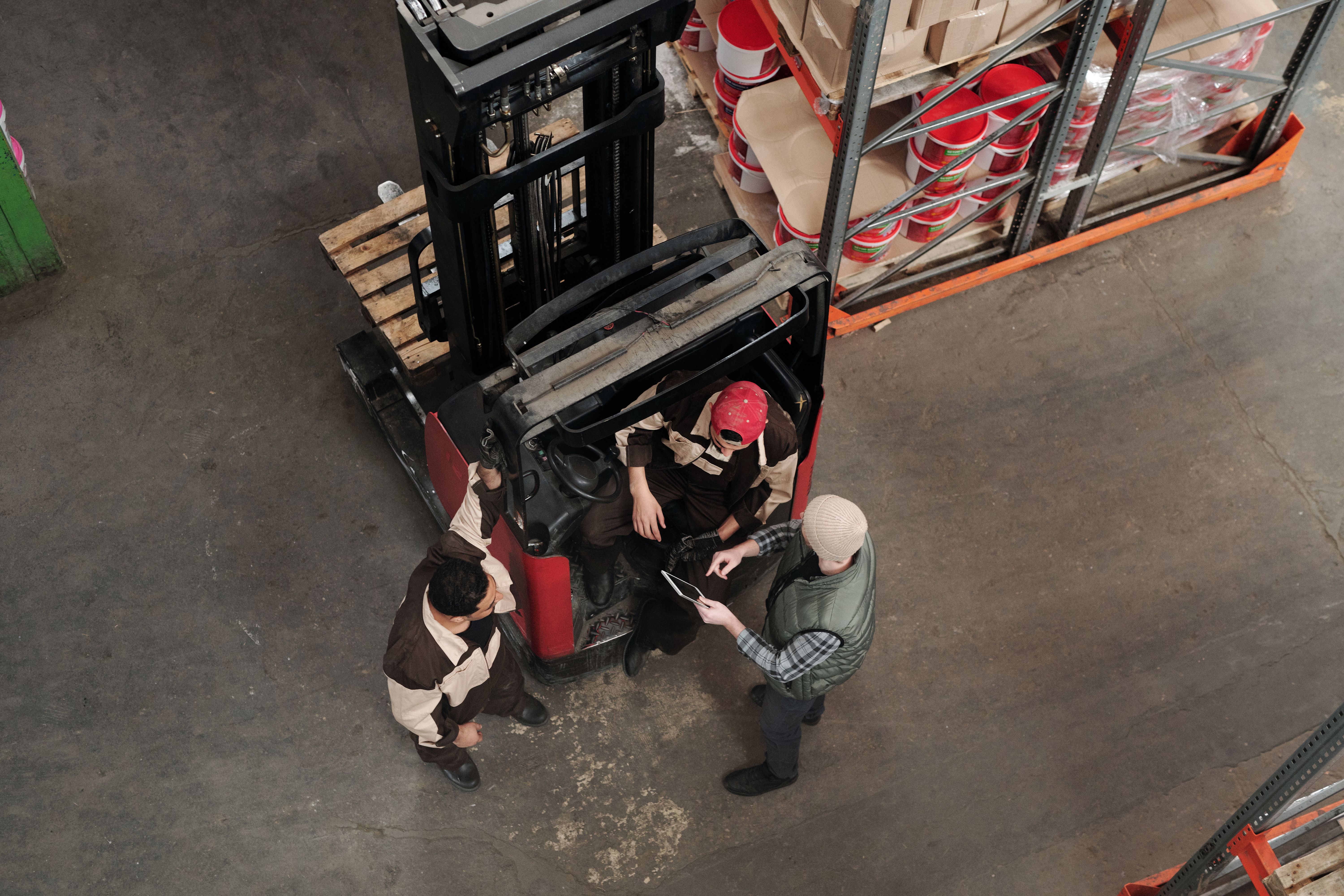
Audit preparation comes down to three things: getting your documentation and facility in order beforehand, making sure your team knows what to expect, and running the day itself smoothly once the auditor arrives.
Pre-Audit Preparation
Start by reviewing the specific standard or scope you're being audited against so you know exactly what the auditor will be checking for.
From there, walk your own facility using an internal checklist to catch weak points before the official visit, paying particular attention to hard-to-clean areas like behind equipment and under sinks, not just what's visibly dirty. Keep your HACCP plan, allergen protocols, cleaning schedules, and training records centralized and up to date so that anything the auditor asks for can be retrieved quickly rather than hunted down on the day. A mock audit is one of the most effective final steps:
- Daily checks
- Fridge logs
- Staff interviews
If you act as though the audit were already happening, you can catch gaps in real time rather than in front of the inspector. If your audit covers a specific product type or certification (like gluten-free), make sure that's actually what's in production that day.
Audit Day Best Practices
First impressions matter — a clean, tidy site (inside and out, with adequate parking) signals seriousness before the auditor opens a single document.
Brief your team in advance on what to expect, who's leading the opening and closing meetings, and how to behave during the inspection. Make sure senior staff are present for both meetings, and floor staff should be ready to answer questions directly.
Assign at least two staff members to escort the auditor throughout the day, and set up a quiet, private workspace stocked with water or refreshments and Wi-Fi access — auditors will spend real time there reviewing paperwork, and long stretches of silence while they work are completely normal. Make sure the auditor is briefed on site rules, safety procedures, and protective clothing requirements, and has completed any required sign-in or health questionnaire.
When questions come up, answer directly with documented proof rather than guessing or downplaying issues — auditors are far more receptive to a clearly explained gap than to something that looks concealed. Take your own notes throughout the day so you can follow up on anything raised.
Finally, treat the audit as a resource rather than a test to survive.
A flagged issue is information you can act on, and auditors are generally there to help you improve.
How Manufacturing Software Makes You Audit-Ready Year-Round
.jpg)
Manufacturing software shifts audit preparation from a last-minute scramble into something a business maintains automatically as part of daily operations.
Platforms like Sutton build this continuous readiness directly into production and inventory workflows, rather than treating audit prep as a separate task done before an inspection.
Sutton tracks lots from receiving through to finished goods, recording every movement in real time through barcode scanning, so a business can pull up the complete history of any item on demand — exactly the kind of evidence an auditor or reviewer needs. Because purchasing and production data live in the same connected system, questions about where an ingredient came from or where a batch ended up can be answered directly from the record instead of being reconstructed after the fact.
Sutton tracks materials and finished goods across multiple sites and bins, manages recipes and bills of materials with version control and cost tracking, and allows businesses to set reorder points that help avoid stockouts and expired inventory issues that frequently show up as audit findings. Because production is planned against actual demand and available supply, the system also reduces the overstocking and understocking problems that create their own compliance risk.
Want to see for yourself how Sutton can help you with your food safety audits? Book a call with one of our experts who can show you practical examples of how the software can help you based on how your company actually works.
%20(1)%20(1)%20(1).jpg)
.jpg)