


What Is a Manufacturing Process?

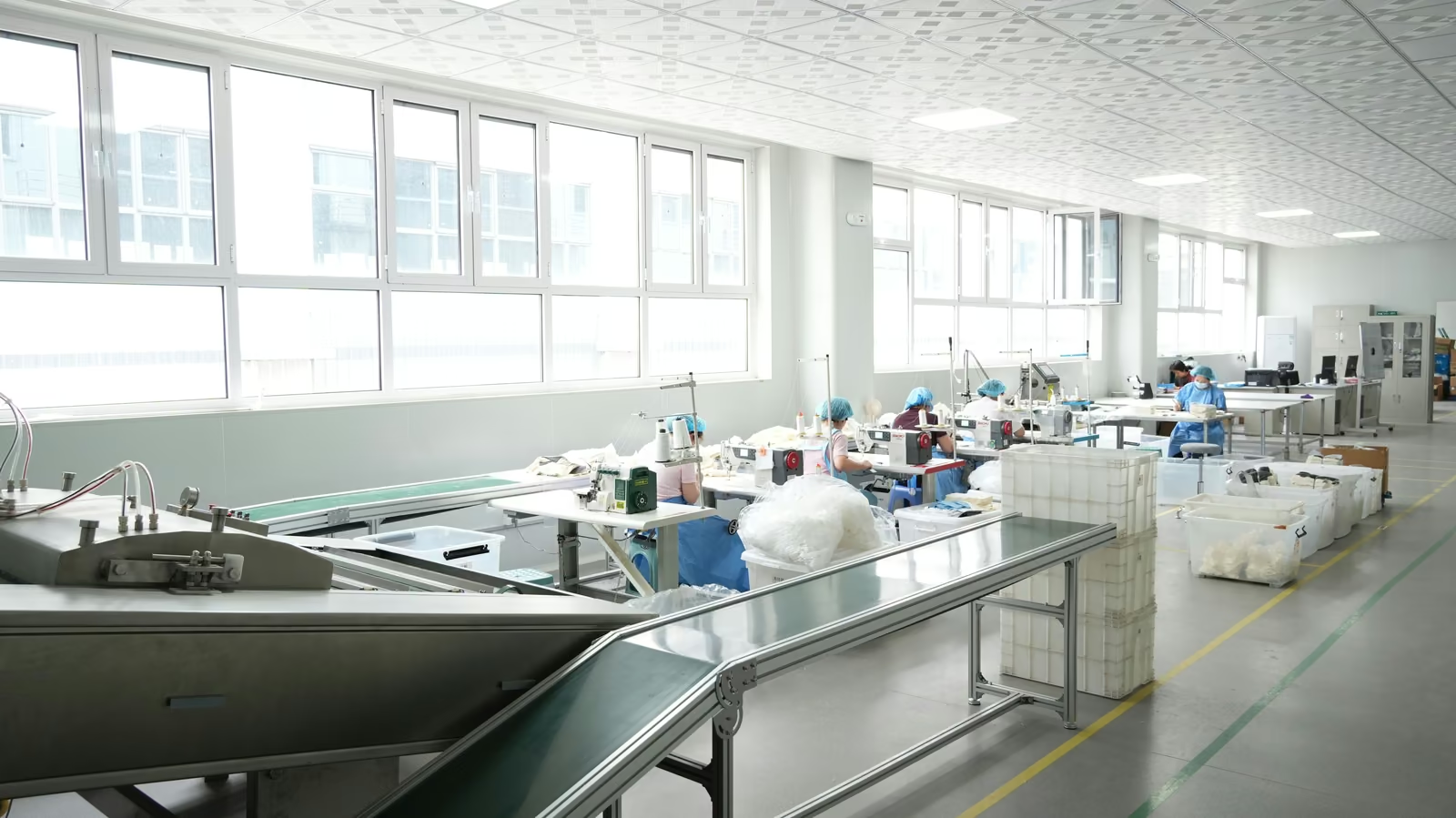
A manufacturing process refers to the workflow or steps that must be followed in a specific order to convert raw materials and components into a finished product.
A manufacturing process doesn’t have to be linear either. It can cover the manufacturing of a subassembly that will later be used in another production flow to create a final product. Regardless of when the process starts and finishes, it will encompass the use of:
- Labor
- Machinery
- Tools
You can track your manufacturing process by implementing software or using manual documentation methods, such as spreadsheets or whiteboards. Regardless of how you document and follow your process, you can basically consider whatever you record to be a Standard Operating Procedure for everyone in your company to follow. Making one little change can change the output of production and how lean your processes operate. This is why it's important to keep your manufacturing process structured, as it gives you a way to:
- Improve product quality
- Lower production costs
- Optimize efficiency
- Reduce environmental impact
The 6 Stages of Your Manufacturing Process
Even though the process of a food and beverage producer will be vastly different from that of an electronics manufacturer, the stages that define their process stay the same.
Here are the 6 stages of a manufacturing process every business will follow, from start to finish.
1. Design and Product Development
Every idea eventually has to be translated into something tangible, and that’s where we start with the design and development phase.
Here we’re creating all the necessary documents that are going to help operators understand how to create a product, with things like:
- CAD models
- Technical drawings
- Bill of materials (BOM)
Depending on your industry, there are certain requirements a product must meet (such as functional, performance, regulatory, mechanical, and electrical requirements). Any additional criteria a product must meet as it moves through your manufacturing process should be defined in your Product Requirements Document (PRD).
With the theoretical part of the manufacturing process now out of the way, we can move on to product development by creating your prototypes.
It’s pretty much guaranteed that your product will evolve as you realize there are more cost-efficient methods of building something, so with your “alpha” build, you’re just concerned with proving the technical feasibility of your product, while your later “beta” versions are there for validation testing and will more closely resemble your final product.
2. Material Sourcing and Procurement
With designs done and prototyping over, now it’s time to find vendors who can supply you with the raw materials and components needed to manufacture your product.
At this stage, you’re not only on the hunt for suppliers, but when you do find them, you’re trying to figure out:
- Pricing and contracts
- Confirming lead times
- Validating that supplier quality meets your defined standards
If you’re manufacturing a product that has a long lead time or is particularly pricey to build, then you need to find a reliable supplier (or multiple) because turnaround time on manufacturing is going to already be elongated by the complexity of a certain material or components, and if a supplier drops the ball here, then you’re going to have an even longer production cycle and dissatisfied customers.
3. Production Planning and Scheduling
You have your plans and (ideally) several suppliers who can get you the items you need for your finished products — the next step is to figure out how you’re going to manage your production runs.
At the production planning and scheduling stage, you’re essentially trying to figure out how much time and resources you need to get a production run finished, and to do this, you’ll need to do some capacity planning, looking into:
- Labor
- Equipment
- Materials
You’ll also need to define your manufacturing routing (an important factor in the manufacturing process). What this means is that you’ll want to define the order in which operations need to be completed, which gives you essentially a map of how items move between your machines, work centers, or departments, and lets you document how long it takes to set up and how long it takes the item to pass this step.
With production planned, you can start assigning start and finish times to all your jobs and batches, factoring in:
- Batch size
- Equipment availability
- Customer delivery dates
4. Production Execution
With everything planned, now’s the time to get manufacturing moving by releasing your work orders to your operators.
We’ll delve into the different types of manufacturing processes later, but at this point, the actual production run is either manual or automated, and the items and components will move along your shop floor until they become a finished product, going through whatever stages they need to go through, including things like:
- Cutting
- Molding
- Casting
- Joining
- Assembling components
If you’re using manufacturing ERP software, this progress can be tracked in real time through barcode scanning during the production run and other shop floor control systems.
5. Quality Control and Inspection
This is especially important if you’re a business operating in a regulated industry, but it is always good practice to do so even when there are no legal repercussions, as faulty products will still damage customer trust and harm your brand image.
You can perform inspections after a production run, though it’s better to do so during production at specific checkpoints, since the earlier you detect a problem on your manufacturing line, the sooner you can nip it in the bud.
During this stage, it’s not just a matter of making sure everything was designed to specification, but also ensuring that your actual performance matches what you had planned. You should perform an analysis to surface:
- Production delays
- Cost variances
- Recurring quality issues
By addressing potential gaps during the production run, rather than uncovering them afterward, you can correct issues before they become larger problems downstream and review your plans and schedules to improve future planning.
6. Packaging, Storage, and Distribution
But if everything is hunky-dory, you can now wrap up production and get those products wrapped up for delivery.
This means getting everything packaged to keep it safe during storage and transit, with all the proper labels and documentation kept with the package. Assuming there’s already demand for these products, the final steps involve getting the item to the customer on time and in one piece, by:
- Selecting carriers
- Scheduling shipments
- Managing order fulfillment
And that’s your entire manufacturing process broken down into 6 stages. But, as already discussed, manufacturing processes differ from industry to industry and business to business.
The Five Types of Manufacturing Processes
.png)
There are five types of manufacturing processes that a manufacturer can use when deciding how to manage their production.
However, it’s not a matter of picking the one that sounds the most exciting to you, as each type has its own advantages and disadvantages, and choosing one will largely depend on:
- Production volume
- Product variation from unit to unit
- Physical form of the raw materials (something solid vs. liquids, gases, powders, or slurries)
Let’s look into each type of manufacturing process in more detail, starting with:
1. Repetitive Manufacturing
When you ask anyone to picture manufacturing, this version of it is likely the thing that gets conjured up in their head:
Assembly lines running 24/7, producing the same item one after the other
This is great for any business that has stable customer demand, produces large quantities of the same product, and has a standardized manufacturing process to improve profitability through automation and lean manufacturing. If you’re a fan of Breaking Bad, think Season 5, when Walter White and Jesse Pinkman are looking for a base of operations, and consider a tortilla factory.
The risk of repetitive manufacturing is that if a problem occurs along the production line, every product that passes through is affected until it is identified.
Repetitive manufacturing is a common sight in industries such as:
- Electronics
- Food production
- Toys
- Automotive
2. Discrete Manufacturing
Discrete manufacturing also runs on a production line, but each unit is treated as a distinct item with its own specifications, allowing variation within a broader product family.
It sits between repetitive and job shop manufacturing — fast like a repetitive line, but able to accommodate customization at the cost of frequent changeovers when configurations switch. Coordinating this many moving parts, with different setups and timing at each station, demands tight scheduling to keep the line balanced.
Used for aircraft, furniture, appliances, and medical devices, where units differ from one another.
3. Job Shop Manufacturing
Rather than an assembly line, production moves through individual workstations, with skilled workers completing specific operations before passing the item along.
This is the oldest form of manufacturing, tracing back to craft and guild production, and remains best suited to highly customized, low-volume, or one-off work where no two orders are identical. The slower pace supports closer quality control, since workers have time to catch and correct flaws before an item moves on.
Common in aerospace and defense components, custom cabinetry, and specialized industrial machinery.
4. Batch Manufacturing
A fixed quantity of one product is produced, then equipment is reset before a different product runs — similar to a bakery finishing one recipe, cleaning down, then starting another.
This method suits products where raw materials, often liquids, powders, or slurries, need to be blended, and fits order-driven production where required quantities vary. It's flexible between batches but rigid within a single run, since specifications are locked once production starts.
Common in food and beverage, pharmaceuticals, and plastics.
5. Continuous Manufacturing
Production runs nonstop, moving raw material (typically gases, liquids, powders, or slurries) through the process without interruption, since many of these operations depend on ongoing chemical or physical reactions that can't be paused without disrupting the result.
It shares repetitive manufacturing's around-the-clock output but differs in handling flowing materials rather than solid, discrete parts.
Common in oil refining, chemical processing, fertilizer production, and pharmaceutical manufacturing, where uninterrupted conditions are essential to consistent quality.
Discrete vs. Process Manufacturing: What’s the Difference?
Discrete manufacturing produces countable, separable units tracked via a Bill of Materials.
Process manufacturing produces bulk goods by mixing formulas that can't be unmixed once combined.
6 Production Strategies You Can Use in Your Manufacturing Process
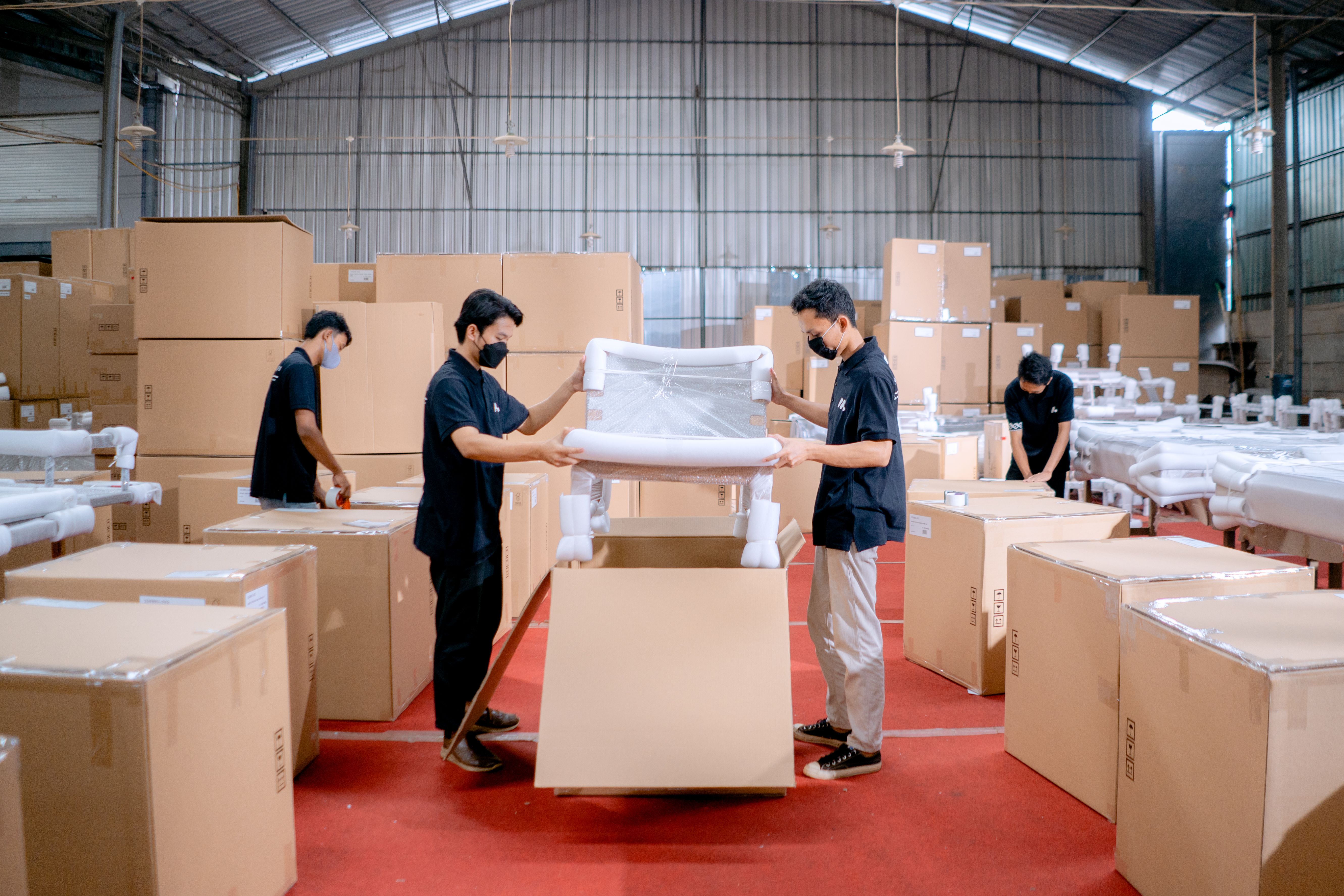
Production strategy determines when in the order cycle manufacturing actually begins — before demand materializes, only after a customer commits, or somewhere in between.
The right choice depends on how predictable demand is, how customized the product needs to be, and how much inventory cost the business can absorb.
1. Make-to-Stock (MTS)
Products are manufactured against demand forecasts and held in inventory, ready for immediate fulfillment when orders arrive.
This suits high-volume goods with stable, predictable demand, such as consumer staples, packaged foods, and similar categories, where stockouts are costly but customization isn't expected.
The trade-off is demand-forecast risk.
Overly optimistic projections lead to excess inventory and obsolescence, while underestimating demand leads to shortages. MTS works best when a business has reliable historical sales data and a broad enough customer base that individual demand fluctuations average out into a predictable pattern.
2. Make-to-Order (MTO)
Production doesn't start until a customer places an order, which keeps inventory holding costs low and avoids producing goods that may not sell.
This fits customized, high-cost, or low-volume products such as industrial equipment, computer hardware, and similar goods, where holding finished stock would be wasteful or impractical.
The trade-off is lead time.
Customers wait longer to receive their orders because manufacturing occurs after commitment, which requires clear communication and reliable scheduling to manage expectations.
3. Assemble-to-Order (ATO)
Standard components are manufactured and stocked in advance, but final assembly waits until a customer order specifies the exact configuration.
This strategy splits the difference between MTS and MTO — it delivers faster than full made-to-order production while still allowing meaningful customization at the final stage. It works well for product families built from a common set of modular parts, where most of the manufacturing complexity can be handled in advance, and only the final step depends on the specific order.
4. Engineer-to-Order (ETO)
The most customized manufacturing process approach.
In the ETO workflow, design and engineering begin only after an order is placed, since the product doesn't yet exist in a standard form. This is used for large, complex, one-off projects (ships, aircraft, industrial facilities) where each order effectively requires new engineering.
ETO demands close coordination between engineering and production teams and results in the longest lead times of any strategy, but it's the only viable approach when products can't be standardized in advance.
5. Level Production
Manufacturing output remains constant despite short-term demand swings, building inventory during slow periods to cover peaks without changing the production rate.
This simplifies scheduling and equipment utilization and suits industries with cyclical or seasonal demand but limited capacity to rapidly scale production up or down.
The trade-off is inventory cost.
You’ll be accumulating stock during off-peak periods and carrying holding costs until demand catches up.
6. Chase Strategy
Production output is adjusted in near real time to track actual demand, keeping inventory levels close to zero.
This minimizes holding costs and the risk of unsold stock and suits businesses with limited resources or narrow, time-bound demand windows (seasonal products are a common example).
The trade-off shifts from inventory cost to operational strain.
Scaling labor and resources up and down repeatedly puts pressure on workforce planning and production flexibility.
How Software Supports Each Manufacturing Process Type
Visual input: A worker on the shop floor holding a handheld barcode scanner up to a labeled part bin.
Each manufacturing type creates different operational demands, from tracking countable parts to managing continuous material flow, and the software supporting it needs to match.
Digit is built to flex across these needs from within one connected system, rather than requiring a separate tool for each.
Discrete Manufacturing
Discrete production depends on accurate, multi-level BOMs and tight coordination between planning and the shop floor.
Digit supports this with BOM revisions and alternate BOMs to keep costs and versions controlled, work orders built around routings and work centers, and yield and time tracking that feeds directly into true job costing.
Process Manufacturing
Where materials blend or convert into a final product, traceability and proportional accuracy matter most.
Sutton's lot and serial tracking keeps current quantities visible at every stage, while yield and scrap factors within its BOM tool, combined with automatic unit-of-measure conversions, help manufacturers maintain accurate proportions as materials move through production.
Job Shop Manufacturing
Custom, order-driven work needs scheduling that can shift quickly and history that follows each job individually.
Sutton's MO calendar and built-in job scheduler let teams set priorities and due dates as orders change, while history tracking on items and operations preserves a clear record from quote to delivery.
Repetitive Manufacturing
High-volume lines need to stay fed without excess inventory sitting idle.
Sutton's demand and supply planning gives a unified view of stock and requirements across sites, with safety stock levels and suggested purchase and manufacturing orders keeping material flowing in step with capacity — supported by barcode scanning that updates inventory as stations consume parts.
How to Choose the Right Manufacturing Software
.jpg)
Choosing the right system starts with understanding the operation it needs to support, not with comparing vendor feature lists.
1. Map Your Operation
Audit workflows, bottlenecks, and production goals before evaluating any vendor. The software category should follow your operational profile, not the other way around.
2. Match Software Type to Problem
Not every challenge calls for a full-blown overkill ERP. When bottlenecks span inventory, production, and purchasing together, a unified platform like Digit removes the need to stitch several standalone tools into a single workflow.
3. Evaluate Total Cost of Ownership
Implementation, training, and support typically add 1–2 times the annual license cost for enterprise ERP systems, with median project costs reaching $450,000 and over a quarter of organizations exceeding budget.
Factor in the full project lifecycle, not just the license fee.
4. Verify Integration Depth
Confirm the software connects natively to your existing stack.
For example, Digit integrates with tools like QuickBooks, Shopify, WooCommerce, Amazon, and eBay, syncing sales and accounting data without added middleware.
5. Prioritize Flexibility
Operations change (new product lines, new workflows, new compliance needs), and software should adapt to them.
Digit's configurable labels, BOM revisions, and alternate BOM structures let teams adjust their processes as they scale, without depending on constant custom development work.
And there you have it! Everything there is to know about the different types of manufacturing processes and how you can implement them into your business. If you’re at the stage where you're looking for a tool to help you manage your processes, we recommend Digit.
If you book a call with us, we can give you a tour of the product and show you how the tool works through scenarios tailored to your specific business.
.jpg)