



What Is an ERP AI Assistant?
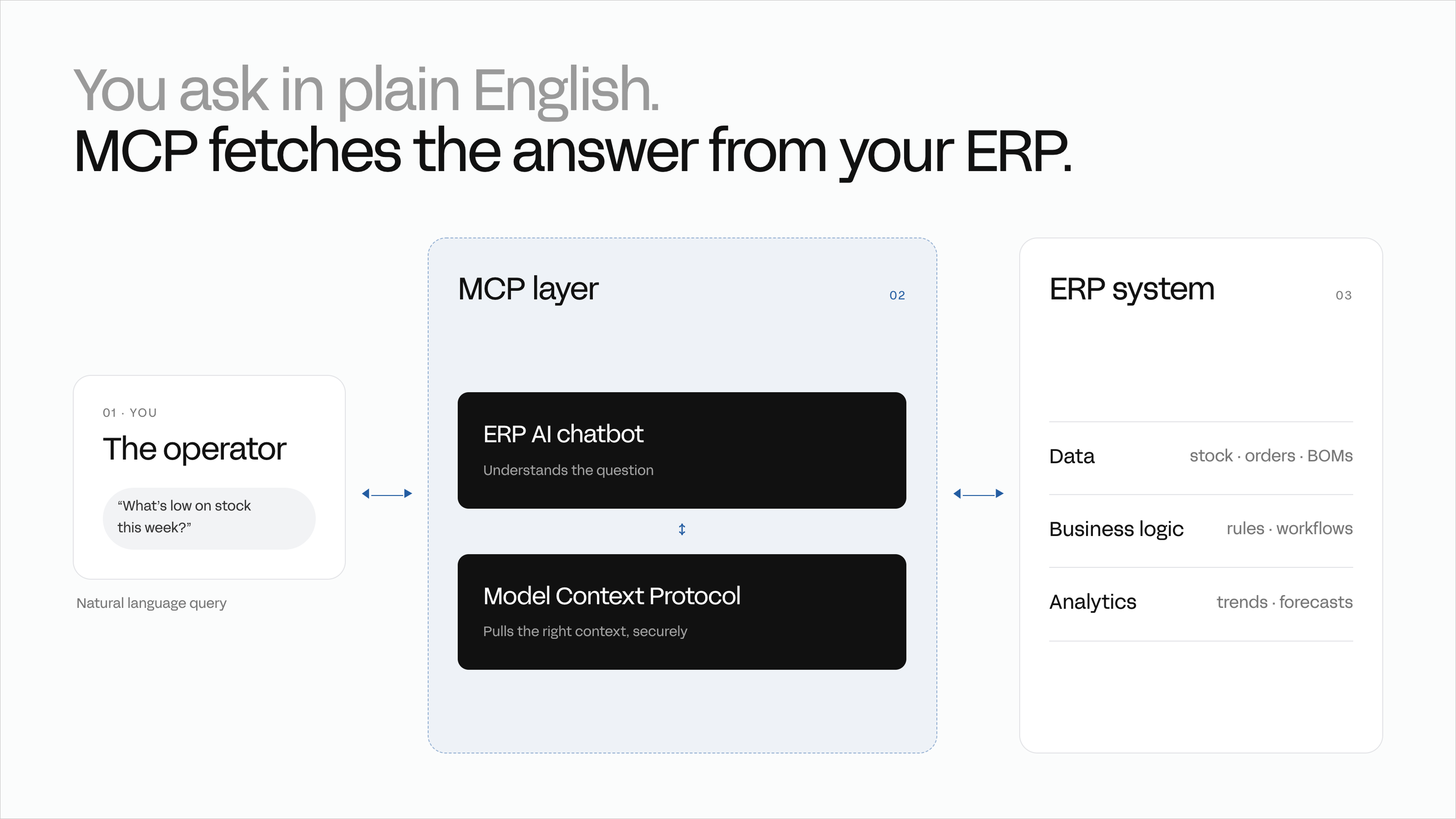
An ERP AI assistant is a tool that either comes pre-built with manufacturing ERP software or integrates with one to assist users in using the software and running a business.
These AI systems use natural language processing and machine learning, which allow them to help people with all different software tasks, such as:
- Manage and interpret company data
- Automate repetitive tasks and routines
- Execute tasks either directed by an operator or autonomously
How much an ERP AI assistant can do can be defined by either you or the software vendor, but most applications of these tools come in the form of providing prompters with real-time answers to whatever questions the user might have, saving them from the hassle of having to pore through dashboards or reports, or jump between different software or tools.
But let's take this even further and do a deep dive into what these AI assistants bring to the table.
6 Things That an ERP AI Assistant Can Do
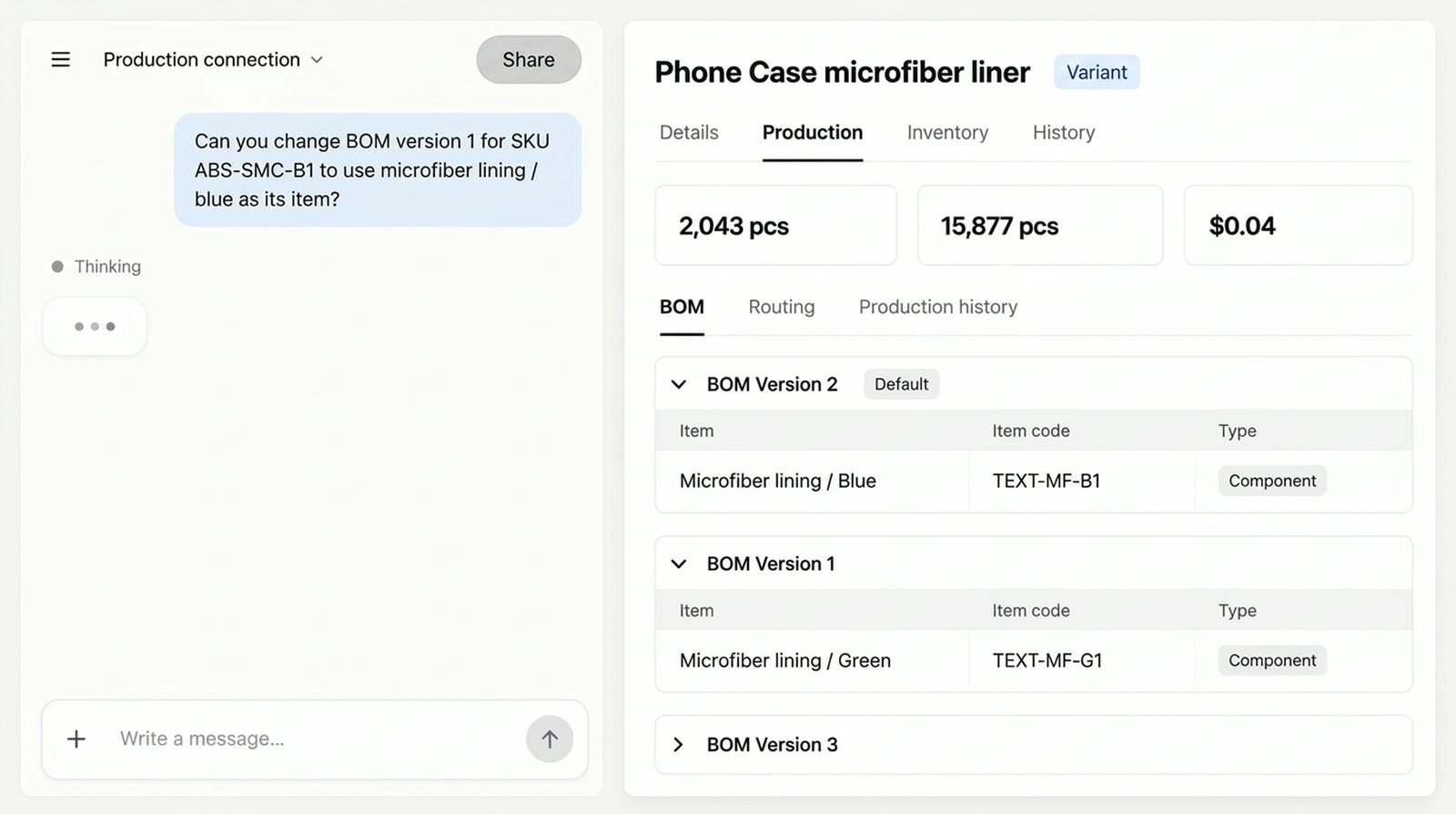
An AI ERP ultimately helps manufacturers reduce the time and effort it takes to perform the day-to-day tasks of running and managing their operations — freeing you and your team to provide more value to your customers.
Here are 6 things an AI ERP bot can do to help your operators focus on manufacturing, starting with:
Conversational Queries and Instant Reporting
Most ERP tools, especially legacy systems, are insanely complicated to learn and understand.
The old-timers who've been using the software since the 1980s might breeze through it, but if you drop a newbie onto the software, they're just going to be overwhelmed by how everything is presented. Using an ERP chatbot means that at any point an operator is struggling to find information (for example, checking current inventory levels), they can just turn to AI for guidance on how to find the correct screen or even just bypass that altogether and have the AI report the findings back to them in a chat.
Although it's always good practice to onboard your team, you could essentially just point them to the AI ERP chatbot if they have any questions or are struggling to find reports.
Workflow Automation and Approvals
Depending on how the AI ERP chatbot is configured, you can set it up in a way that it is able to execute certain actions, such as:
- Approving a purchase order submitted by an operator
- Reviewing timesheets
- Approving a worker's PTO straight from a chat interface
By handing off these types of approvals to the AI, you eliminate the potential blocker of having a manager step in to approve and get decisions made faster, which your employees will definitely appreciate (especially having their holidays confirmed basically the instant they submit them).
Insights, Forecasting, and Strategic Analytics
One of the trickiest things about manufacturing is trying to calculate and forecast future demand — which ERP with AI assistants will be able to help with.
AI chatbots can analyze data to detect anything that can potentially disrupt operations, like upcoming inventory shortages or capacity issues, by:
- Surfacing trends
- Flagging anomalies
- Warning of stockouts before they occur
This is a relatively new feature appearing in more and more MRP software and ERP systems alike. Traditionally, forecasts have been based on historical data, but now, with AI, it's easier to predict upcoming demand as it continuously analyzes data.
What this essentially means for manufacturers is that they can get ahead of risks and even identify opportunities in real time, enabling managers to make better decisions based on observations from an ERP AI bot.
Data Accuracy and Compliance
The reason most manufacturers eventually turn to cloud-based manufacturing software is that using spreadsheets and manually entering data is constantly at risk of corruption from a single mistake.
But even then, the software needed an operator to keep an eye on things, ensure the data was correct, and make sense of all the information it displayed. But with the introduction of AI chatbots into this software, you basically don't even need to analyze the data (though you should still always validate it every now and again). The best ERP AI chatbot will flag any inconsistencies with the data as soon as they appear, allowing manufacturers to implement stronger data integrity and ensure compliance, with very little extra work to do this.
HR Support, Productivity, and Customer Experience
An ERP AI assistant can also help beyond the shop floor, assisting your HR team with any questions workers might have, such as:
- Payroll
- Time off
- Benefits
By having an AI ERP chatbot that your team can funnel questions to, you allow your people departments to focus on higher-value tasks.
Scaling With the Business
Finally, with almost every aspect of your business now being able to offload at least some repetitive and (let's be honest) annoying tasks to the ERP AI chatbot, you and your team can concentrate on growing the business.
And it's not just because your teams will have less work that you'll be able to redirect capacity and resources. Ultimately, an AI chatbot operates as a copilot for everyone in the company, meaning they can better handle and analyze higher volumes of data, adopt new workflows as the AI assists them with onboarding, and even break into new markets as market-specific SOPs will be quicker to generate.
But before you rush off to the internet and try to find a solution, there are a bunch of different tools that exist on the market, so it's important to find the one that will solve the problems that you want to overcome with your tool.
What to Look for in an ERP with AI
.jpg)
Shopping for an ERP with AI means checking for automation that runs continuously in the background, conversational tools that respond to plain language, and strict controls over how your data gets used.
None of that delivers much value if the data underneath it is a mess, though. AI can only act on what it's given, and it tends to amplify the quality of that foundation without repairing it, so the data layer deserves as much scrutiny as the AI features themselves.
A conversational assistant should let people query sales, manage inventory, or reports using everyday language instead of complex database codes.
Predictive forecasting should analyze historical trends, market signals, and seasonal shifts to flag supply chain risk or cash flow trouble before it happens. Anomaly detection should rely on machine learning that continuously monitors transactions, catching duplicate invoices and unusual spending before they turn into bigger problems, while also standardizing QA processes and keeping an audit trail automatically. Document processing, using computer vision to read vendor invoices and convert them into coded data without manual entry, rounds out the list.
These four hold up because they're constrained, as the AI matches patterns against a known category of data. It isn't generating new numbers or logic from scratch. That distinction matters more in ERP than almost anywhere else. Accounting depends on deterministic, rule-based accuracy, while generative AI is inherently probabilistic, producing its best guess based on patterns it has seen before. Anomaly detection, forecasting, and invoice classification stay on the safe side of that line. Open-ended generative AI that writes journal entries or financial figures does not stay on that side, and that's exactly where hallucination becomes unacceptable in a system of record.
A Real-Time, Unified Data Foundation
None of these features work reliably on fragmented data.
If a warehouse system only syncs to the general ledger once a week, an AI agent that asks whether stock is available for an order is working from information that could already be five days stale, and it will end up guessing, and the answer likely won't be accurate. Conflicting inputs fed into a model from siloed systems don't get filtered out along the way. They get amplified, the same way rolling bad steel spreads a defect through everything built from it afterward.
AI built into the core of a platform works differently from AI bolted onto an old, disconnected system as a chatbot layer. The difference is closer to installing central air conditioning throughout a house versus mounting a window unit in one room, since one is designed into the structure while the other is an add-on wrapped around it. Some in the space see this pointing toward a longer-term shift, where ERPs become thinner orchestration layers, a data warehouse becomes the source of truth, and AI sits on top as the interface and automation layer.
A fair vendor question is whether the system offers an open API, an MCP server, or a similar connector, or only works well inside its own walled garden.
Continuous, Always-On Automation
Look for AI agents that run constantly in the background, without needing to be manually triggered each time.
Bank reconciliation should match transactions in real time through a direct banking connection. It shouldn't wait to run once a month against a static statement, and it should surface exceptions for a person to review, without posting everything on its own. Transaction categorization should learn from how your team has categorized things before, auto-apply the matches it's confident about, and flag the uncertain ones, improving with every accept or reject decision. Recurring journal entries should get scanned for historical patterns and pre-filled as drafts on the day they're expected, handling nearly all of that work without extra setup. Month-end close should run off a dynamic checklist tied to live data, without relying on a static list in a spreadsheet, with the system completing what it can and updating status on its own.
For a multi-entity business, this same continuous approach should extend into consolidation.
Intercompany eliminations should post automatically the moment a transaction is recorded. Shared expenses should be allocated across entities according to the guidelines your team sets. Multi-currency translations should be calculated automatically at the point of consolidation. A strong platform can also analyze charts of accounts across every entity, group the near-matches, and standardize them into a single structure, with entity-level and consolidated views available instantly. Treat it as a warning sign if multi-entity support is sold as a separate module, if intercompany accounting is something a consultant configures by hand, or if elimination entries still get built in a spreadsheet at month-end.
Governance, Audit Trails, and Human Oversight
The AI should inherit your existing permission structure and not operate outside it, so sensitive payroll or financial records remain hidden from anyone who isn't supposed to see them.
Ask where your prompts and data get processed, how long that information is retained, and whether it trains a shared public model. Every AI action should carry a confidence score and leave an audit trail, with work surfaced for a person to review before it's finalized, without the system acting unilaterally. Even with messy source data underneath, a well-designed human-in-the-loop step keeps the risk manageable. The strongest systems build in feedback loops so accuracy improves as people correct mistakes, and some rely on multiple LLM providers chosen per task, without depending on a single model for everything.
Before signing anything, it's worth asking a vendor where human review sits in their workflow, what the audit log captures for an AI-generated entry, and how the system learns when it gets something wrong.
Why Small Manufacturers Benefit Most from Conversational ERP

Small manufacturers get the most value out of conversational ERP because natural language interfaces remove the steep learning curve and heavy data-entry burden that traditional software demands.
- No training needed: Workers can type or speak plain questions like 'How much steel do we have?', without digging through reports and screens.
- Less desk time: Shop-floor workers and managers get instant answers on mobile devices without stepping away to update a spreadsheet.
- Fast data entry: Staff can dictate inventory counts or log finished goods verbally, cutting down on the errors that come with manual entry.
- Real-time insights: Owners get immediate cost and stock updates, letting them make fast calls without needing to hire a data analyst.
Using an ERP AI Chatbot Like Sutton

Sutton is an ERP platform that manages business operations such as sales, inventory, purchasing, and fulfillment, and stores and processes the operational data associated with each function. An AI assistant connects to Sutton through an MCP connector, which lets it read that data and take action on it, including creating an order or checking inventory levels.
Would you like to see for yourself? Feel free to book a call with one of our experts who can take you on a personalized tour of Sutton and show you firsthand how operators use an ERP AI chatbot to manage your entire business.

.jpg)