



What Is Raw Materials Inventory?

Raw material inventory refers to the items, components, and subassemblies you keep stored on hand, ready to be used for a production run.
If you're more financially minded (and we will go through these aspects in more detail a little later), on your balance sheet, raw materials are listed as either current assets or as materials that you intend to consume to make finished goods at some point within the year. Raw materials come in two different types:
- Direct materials: These are the materials that are used in production to make a finished product, based on your Bill of Materials (BOM) — think fabric and thread for a clothing manufacturer, or metal and wood for a furniture maker
- Indirect materials: These are the items that are used during production but don't end up being in the finished product — like lubricants, cleaning supplies, and packaging
Managing raw materials to ensure that you're staying on top of your inventory management requires you to:
- Procure items
- Store items
- Track stock levels of items
The last part is especially important, as trying to do all this without proper tracking in place means you will continue to face stockouts and production delays, or keep excess inventory, which will tie up capital in that stock that could otherwise be reinvested in another area of your business.
That's why those businesses that started their manufacturing journey tend to struggle later.
It was a cheap and easy solution to implement at the beginning, but over time, as orders grow and your SKU catalog scales, your spreadsheets become a full-time job to manage, helping you avoid last-minute surprises from incorrectly entered data.
4 Reasons Why Raw Material Management Is Important
Without raw materials, you have no way to manufacture a product — this alone should be enough to indicate that your entire business is dependent on getting this right.
If you’re not keeping on top of your raw material inventory management, you’re going to see issues:
- On the production floor
- In cash flow
- In product output consistency
Here are four reasons why it’s important to keep your inventory practices in top form.
1. Production Continuity and Quality
To start production on time and meet demand, materials must arrive on schedule and in sufficient quantities to complete a build.
If raw materials don’t arrive on time, or you underestimated how much you needed, production cannot continue, regardless of how well you’ve managed the rest of your inventory. Another important aspect of raw material inventory management is the quality of the items you order too. By sticking to the vendors that provide the materials you’ve already qualified as being ideal for a product, you can make sure that your finished products all meet the same standard for quality and spec compliance.
2. Market Volatility
Inflation, natural disasters, geopolitical situations — almost anything can happen that ends up increasing the price of products.
For example, over the past year, we have seen commodity prices for different raw materials rise and fall due to different factors, things like:
- Copper
- Aluminum
- Crude oil
You need a raw material strategy that factors in the fact that they are constantly changing yet always rising.
By figuring out a way to better forecast and control things that are going to affect your raw material demand, you can get ahead of any issues that might lead to price increases, helping you avoid:
- Increased costs through expedited freight
- Lost production time
- Customers who notice the delay
3. Cost and Capital Control
As we already touched upon, intuitively, you might think that having more on hand just means you’re always ready to meet production demands.
But in fact, this is draining money from your businesses. Holding inventory comes with costs and risks, both of which increase the longer materials sit in storage. Items spoil, become outdated, or incur handling costs that could have been used for products and inventory in higher demand.
4. Sustainability
Then there are costs that extend beyond your business.
By improving how you manage your raw material inventory, you can reduce the amount of waste your company produces, lower your carbon footprint by only running production when necessary, and decrease the amount of materials you have to dispose of.
And there you have it! The four reasons why it’s important to get more control over your raw material inventory management. But its importance doesn’t stop there. It’s also important because:
- More precise product costing, since COGS reflects actual material costs rather than estimates
- Easier quality control, by making it simple to monitor material condition and turnover
- Less time lost searching for materials, through streamlined storage and labeling
- Better on-time delivery and customer satisfaction, since production isn't delayed by missing inputs
- Usage tracking across multiple locations, for manufacturers running more than one facility
Raw Materials Inventory Formulas and Calculations

Raw materials inventory is the foundation of everything you make and the part of the supply chain most likely to quietly derail production. You can have the right demand forecast, the right production schedule, and the right customer order, and still lose it all because the materials aren’t there when the line needs them.
Getting raw materials management right means understanding what you have, when you’ll need more, and where the gaps in your tracking are creating risks you don’t know about yet. Two calculations are worth knowing well. They’re straightforward on paper, but only useful if the numbers feeding them are accurate.
Ending Raw Materials Inventory
This tells you the value of materials still on hand at the end of a period:
Example: A chemical manufacturer starts the month with $10,000 in materials for their chemical plant, purchases $5,000 more, and uses $8,000 in production. Ending inventory = $7,000. That figure carries forward as the beginning inventory for the next period.
Raw Materials Inventory Turnover Ratio
This measures how many times you cycle through your raw materials in a given period:
Example: A shoe manufacturer starts the quarter with $20,000 in rubber soles and ends with $40,000. Average inventory = $30,000. With $68,000 in COGS, the turnover ratio is 2.27, meaning they cycled through their raw materials just over twice that quarter.
Most manufacturers aim for a ratio between 4 and 6. Below 4 usually signals overstocking. Above 6 can mean you’re running lean enough to risk a stockout.
Raw Materials on the Balance Sheet

Raw materials are recorded at cost: purchase price plus shipping, handling, and storage. From there, their value moves through several accounting stages depending on how they're used, as shown below.
| Event | Debit | Credit |
|---|---|---|
| Purchase of raw materials | Raw Materials Inventory | Cash / Accounts Payable |
| Direct materials issued to production | Work-in-Process (or Finished Goods, if cycle is short) | Raw Materials Inventory |
| Indirect materials issued to production | Factory Overhead | Raw Materials Inventory |
| Production completed | Finished Goods Inventory | Work-in-Process |
| Product sold | Cost of Goods Sold | Finished Goods Inventory |
| Materials written off (obsolete/damaged) | Cost of Goods Sold | Raw Materials Inventory |
Raw Materials vs. WIP vs. Finished Goods Explained

Manufacturing inventory breaks down into four core categories: raw materials, work-in-progress, finished goods, and MRO supplies. Each one sits at a different stage of the production process and carries different management demands, but all four are classified as current assets on the balance sheet, and all carry costs beyond the initial purchase price, including storage, handling, and financing.
1. Raw Materials
As we already explained under what is raw materials inventory, it’s the items unprocessed or minimally processed inputs a business holds before production begins.
A manufacturer needs enough on hand to keep production running without interruption, but not so much that capital sits idle in unused stock. By the time a product is finished, its raw materials are often unrecognizable from their original form, and some, like perishable ingredients, carry shorter shelf lives that require tighter management to avoid spoilage or obsolescence.
2. Work-in-Process (WIP)
WIP covers everything currently mid-production: assembled but not finished, cut but not sewn, mixed but not baked. For a bicycle manufacturer, that might mean frames that have been welded but not yet painted. For an apparel maker, it might mean fabric that's been cut but not yet stitched together. Keeping WIP inventory visible matters because it's the stage most likely to hide bottlenecks — materials can sit here longer than expected without anyone noticing until a shipment deadline is at risk.
3. Finished Goods
Finished goods are products that have completed every stage of production and passed quality checks, ready for sale or distribution. Managing this category well means having enough on hand to meet customer demand without overproducing and tying up capital in products that haven't sold yet. Tracking finished goods volume and value also gives a business a clearer picture of its financial position and helps inform future production planning.
4. MRO Inventory
MRO, short for maintenance, repair, and operations, covers the supplies that keep a facility running without ever becoming part of the finished product itself — machine spare parts, cleaning supplies, packaging materials, and uniforms are common examples. MRO is often the hardest of the four categories to manage well, since it can span hundreds or thousands of items sourced from many different vendors, none of which show up in the final product a customer receives.
5 Areas Where Raw Materials Management Breaks Down

Most manufacturers think they have their raw materials under control. But, the data usually says otherwise. Here are the common problems that cause production disruptions:
1. Incorrect Counts
Your counts are wrong, and you don’t know it until it’s too late. Manual tracking with spreadsheets introduces errors every time someone forgets to log a transaction, updates the wrong cell, or works from a stale file. By the time you pull materials for a production run and find a shortage, you’ve already missed your window. The system said you had stock, but the floor disagrees.
2. Disconnected Systems
Purchasing and production are working off different numbers. When inventory data lives in disconnected systems, or worse, in personal spreadsheets, teams make decisions based on different versions of reality. Purchasing orders based on last week's count. Production schedules based on what they were told last month. The result: you either run short mid-run or end up holding stock nobody realized you already had enough of.
3. Ordering Too Late
You reorder too late because your data always lags. Without real-time visibility, reorder decisions are reactive. By the time low stock surfaces in a report, you're already behind. Rush orders cost more, and expedited shipping eats into margins.
4. Inconsistent Suppliers
Supplier variability makes planning a guessing game. A supplier who usually delivers in two weeks but occasionally takes four, forces you to carry excess safety stock, just in case. That buffer has a cost. And when you’re managing multiple suppliers with inconsistent lead times, the math gets complicated fast. Forecasting demand accurately is hard enough before you layer in supply-side unpredictability.
5. Dead Stock
Obsolete inventory accumulates silently. Materials ordered for a product that's been redesigned, discontinued, or never launched don't disappear from your warehouse. They sit there, showing up as assets on the balance sheet while slowly becoming worthless.
Without a system that flags slow-moving or unused stock, you won't know how much of your inventory is actually usable.
6 Steps for Controlling Raw Materials

The practices below aren’t new, but most manufacturers only partially implement them. Almost none of them work without accurate, real-time data underneath.
Step one: Set reorder points based on actual lead times and usage rates, not gut feel. When stock hits that level, a new order should be notified to you before the gap becomes a problem.
Step 2: Run cycle counts continuously instead of annual physical counts. Count a rotating portion of inventory every day or week. This catches discrepancies before they cause production issues.
Step 3: Maintain safety stock for critical materials, sized to your supplier’s realistic lead time variability and not the optimistic version.
Step 4: Diversify your supplier base for materials where a single-source failure would stop production. Having a backup supplier costs almost nothing until the day you need it.
Step 5: Standardize how materials are received, labeled, and stored. Inconsistent handling creates phantom inventory. Stock that exists in the system can’t be located or used.
Step 6: Track all three inventory stages separately. Aggregated inventory numbers hide where your actual problems are.
Managing Raw Materials in Sutton

Here's how a reorder-point notification, a material shortfall, and a restock actually play out inside Sutton, from the first threshold you set to the moment new stock lands in inventory.
1. Set the Reorder Point
Open the raw material item under Operations → Items, and set a minimum stock level in its inventory settings — for example, 50 units for a material like leather. Once saved, Sutton sends a daily email notification whenever stock for that item falls below the threshold.
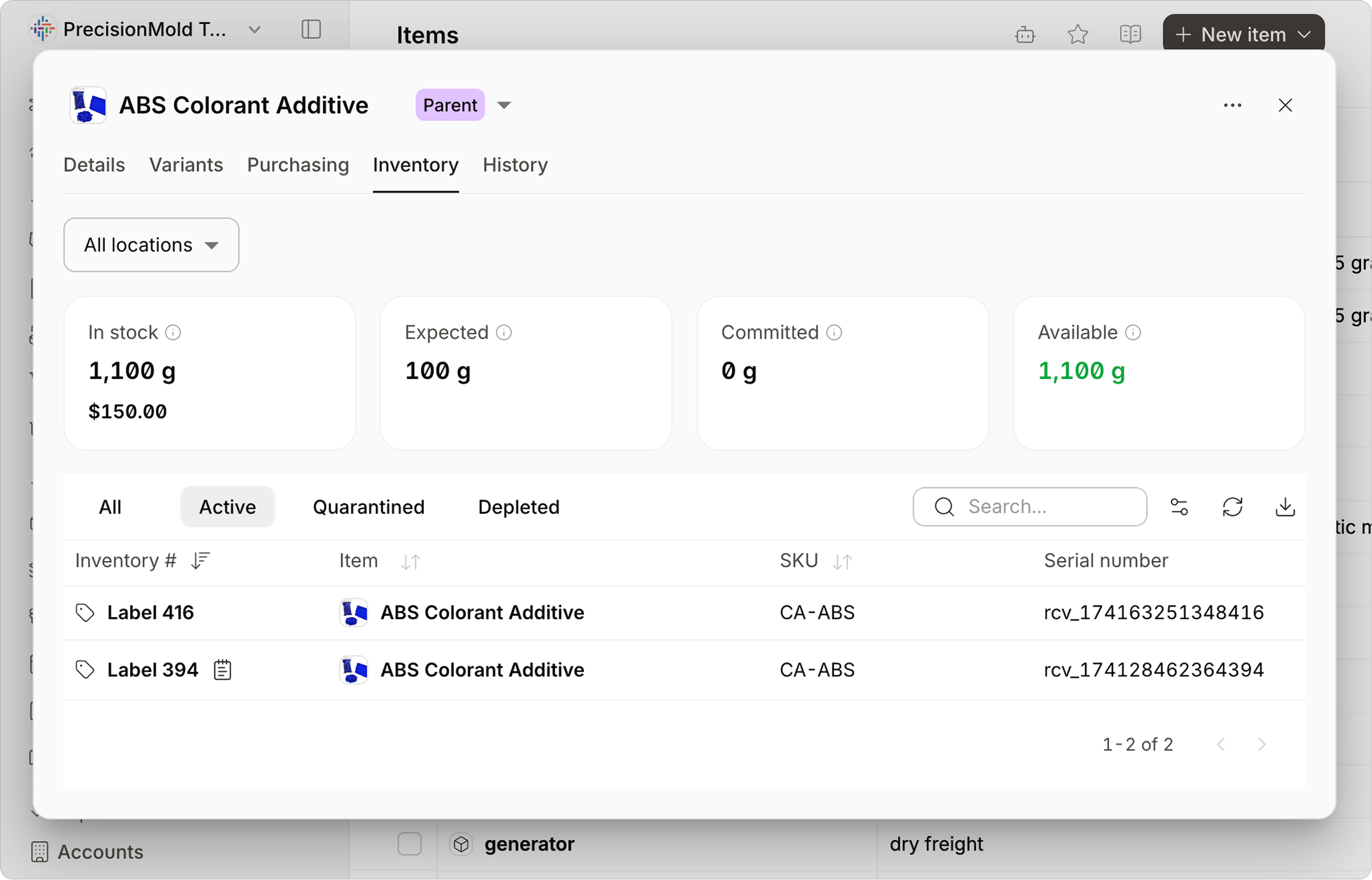
2. Inventory Drops Below the Minimum
As production consumes the material, inventory falls — say, from 60 units down to 30. Sutton flags the item as below its minimum stock level and triggers the notification automatically, no manual check required.
3. Create a Manufacturing Order
From Manufacturing Orders, create a new MO for the finished product and enter the quantity to produce. Sutton pulls the required raw materials directly from the item's BOM and populates them automatically.
4. Check Material Availability
Opening the MO shows a Materials table listing each required component next to its planned quantity and what's currently available. In this example, CHOC-WRAP and CHOC-LABEL both show as available with stock on hand, while the system flags anything short as a gap.
Clicking Pick on an item opens a location-level view, showing exactly which warehouse bin holds the available stock and letting you confirm the quantity to allocate to the order.
5. Create a Purchase Order
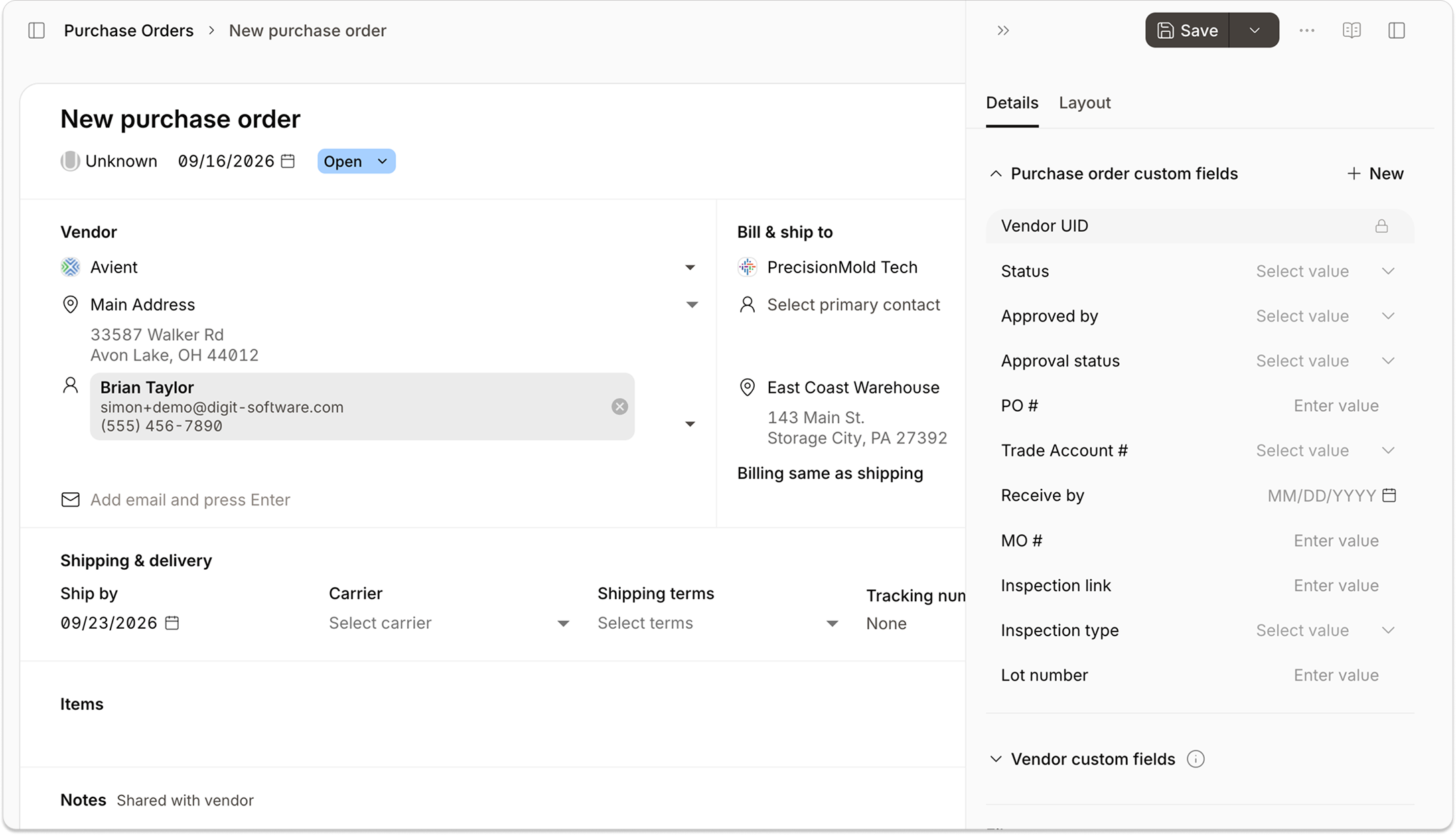
If the Materials table shows a shortfall, go to Finance → Purchase orders and click Create purchase order. Select the vendor, add the raw material item, and enter the quantity needed to cover the gap.
6. Receive the Materials
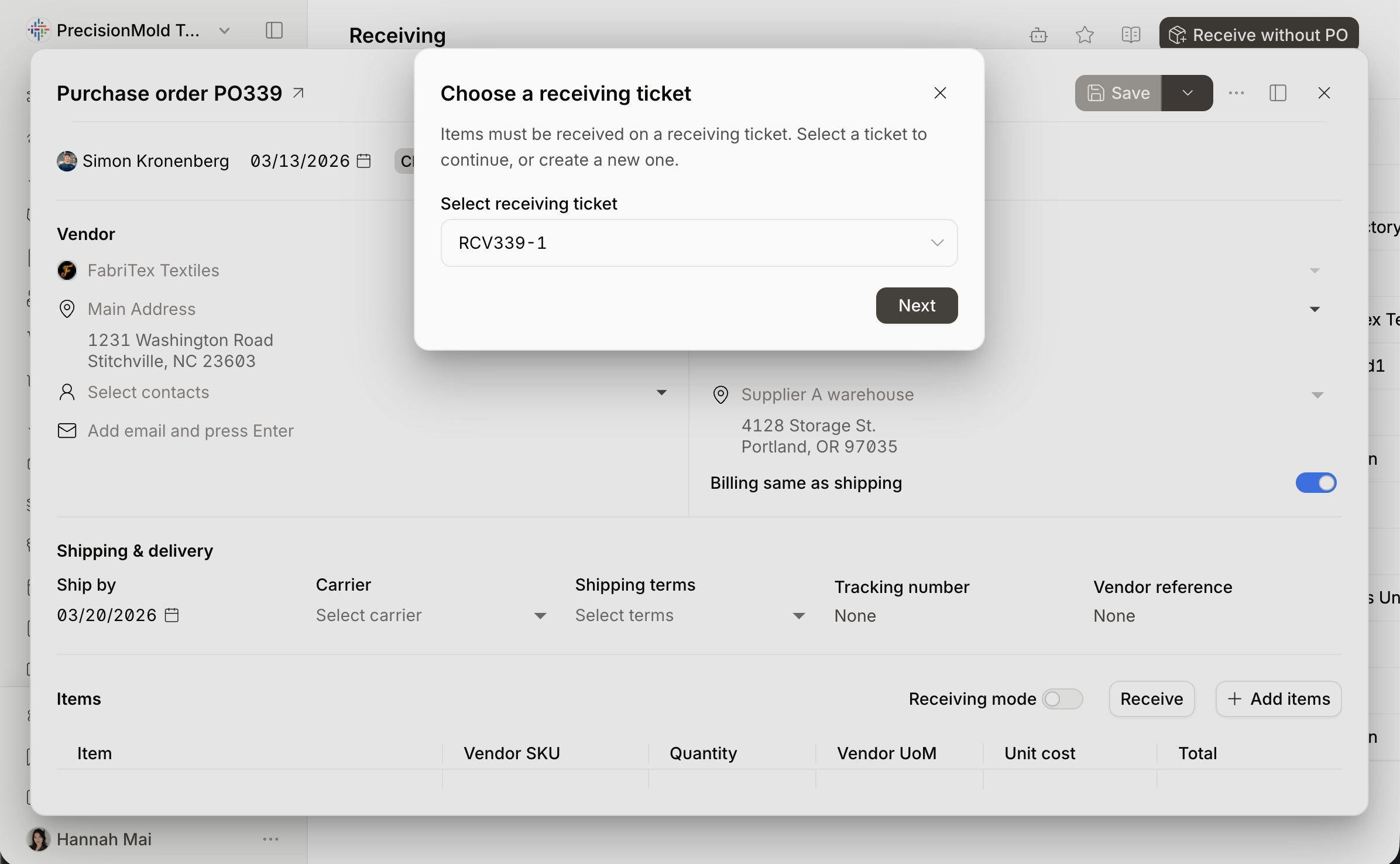
When the shipment arrives, open the receiving ticket under Operations → Receiving and click Accept. Choose the warehouse location and finish receiving — the quantity is added back into inventory automatically, closing the loop that started with the original notification.
If you’re looking for a tool to unify inventory, production, and purchasing while giving you real-time visibility into your raw materials, Sutton uncovers inefficiencies in your raw materials management and lets you run a tighter operation. When visibility into raw materials is working, you’re not guessing. Book a call with one of our experts who can explain how Sutton can help you optimize your raw material inventory management with a specific demonstration using sample data that is typical of your industry.