



What Is AI Production Planning and Scheduling?
AI production planning and scheduling refers to the process of using artificial intelligence tools to manage manufacturing operations and factory schedules by automating and optimizing how you plan and organize your production runs, using:
- Large Language Models
- Predictive Analytics Engines
- Anomaly Detection Algorithms
Until recently, plant operators relied on either manual processes or production scheduling and planning software.
Although the latter was preferable, both approaches are time-consuming because they require someone to input data, and production outcomes depend on how accurate that data is. And because of their need to have a human operator constantly present in the flow and make sense of the data they see and input, these techniques are cumbersome and inflexible. Because spreadsheets or legacy tools don’t monitor the entire production floor, you’re left open to risks such as:
- Equipment failures
- Supplier delays
- Demand fluctuations
Predicting problems in advance requires meticulous planning and keen observation from you and your staff — until AI production planning came onto the scene. Schedules that are created and maintained by AI can adjust production schedules based on real-time data, and if you’re stretched for time and don’t have someone available to review the suggestions being made by AI, then you can even have it set up to make rescheduling decisions for you and even execute the new plans it comes up with.
All this leads to less downtime and higher resource utilization.
The use of AI in production planning is great for helping you with things like:
- Demand forecasting
- Master Production Scheduling (MPS)
- Material Requirements Planning (MRP)
- Capacity planning
- Finite capacity scheduling
- Work order generation
- Task sequencing
- Load balancing
If you’re somewhat interested in the topic of AI, you’re likely already familiar with the concept of there being different versions, like AI copilot for manufacturing or AI chatbots for ERP, but the coolest one out there is agentic AI, which is a system that assumes control of a bunch of different agents and can direct them to perform specific tasks automatically.
Exciting stuff, right? Let’s dig a little deeper and see what else happens when you bring AI into your workflows.
How AI Transforms Production Planning and Scheduling
The first thought that likely pops into your head when thinking about what AI production planning can do for your business is that it will free up your time to focus on other things since you won’t have to worry about manually managing production plans.
Production scheduling AI tools work by monitoring live data from different parts of your organization to generate or suggest schedules, and when something changes, whether on the shop floor or externally, like a delayed purchase order, the software updates schedules immediately.
Here are all the other ways AI for production planning changes the game:
- Data ingestion — A weird word, but that’s what it’s called when raw data is centralized into one place, and how AI does this is by pulling information from your ERP, MES, CMMS, IoT sensors, sales orders, inventory management software, and demand forecasts. This ensures no silos and that any planning decisions are based on the full picture of your business.
- Constraint modeling — Machine Learning (ML) models can monitor and document the constraints that cause production delays and suggest improved schedules to mitigate those delays, including machine capacity, maintenance windows, labor availability, material lead times, changeover sequences, energy costs, and delivery commitments.
- Dynamic rescheduling — We’ve focused mostly on scheduling when it comes to using AI in your workflows, but it can also help you reschedule in seconds based on machine breakdowns, stockouts, or order rushes.
- Continuous learning — AI continuously monitors for the best possible schedule to fulfill your orders, and as it learns, your demand forecasts improve, changeover estimates become more accurate, and capacity predictions tighten with every production run.
Pretty impressive, if we do say so ourselves. But if you're battle-hardened in production planning with decades of experience under your belt, you might not be convinced that handing over your production planning to a machine is the best bet. So, before we look into the benefits, let’s quickly discuss what you’ll be eliminating from your current workflows.
Why Manual Scheduling and Legacy MRP Fall Short

As painful as it is to admit, the early 2000s aren’t yesterday — they were nearly a quarter century ago.
As we get older, we all think that something came out only recently. Like MRPs, for example. You go on Google and search that term, and you’ll find products that sound like they are the latest and greatest invention ever.
But actually, MRPs first emerged in the 1960s!
Even though they are great pieces of technology, they were designed to solve a specific problem:
- What materials do I need to manufacture something?
- And when will I need them to manufacture something?
But since then, countless crises have emerged that make those questions not so simple to answer. And then there are laws and regulations that are constantly changing. For example, if you jumped into a time machine and went to a production line in 1960, no one would bat an eyelid if you lit up a cigarette.
If you’re screaming, just get to the point. We will. The point is that MRPs were created in a different universe, and today's laws, ways of working, and globalization demand more from manufacturers than manual scheduling and legacy MRP tools can deliver.
But let’s explore this further.
Infinite Capacity and Batch Processing
MRP systems focus only on material availability and overlook whether the machinery or labor needed to use that material is available.
In the late 1980s, Advanced Planning and Scheduling (APS) software emerged to optimize manufacturing by balancing real-world constraints like machine capacity, labor, and job sequencing in real time. This allowed factory planners to run instant "what-if" simulations to adapt to sudden disruptions or rush orders. However, it depends on flawless data, meaning even a minor error in estimated machine speeds can produce an unworkable schedule.
As a result, when a manufacturing order is created, jobs are scheduled backward from the due date rather than based on shop floor constraints. Another issue is that older systems, especially those saved locally to a factory desktop, can only handle periodic batch processing or overnight runs rather than live updates, so the data you’re seeing now might be several hours old and irrelevant.
Siloed Data and Fixed Lead Times
Older systems, especially spreadsheets, don’t integrate with other solutions departments might use, such as finance records or live IoT sensor feeds.
As a result, these tools may schedule production on machinery that's about to go down for maintenance, since the maintenance schedule lives in a separate system the planning tool can't see. Both spreadsheets and legacy production planning tools operate more like calculators and aren't capable of accounting for changing lead times, market shifts, or overlapping dependencies.
The Forecasting Fallacy
Older tools often rely on basic forecasting methods, so the forecasts they generate are often rough estimates, and over time the likelihood of those estimates being wrong increases to the point of inevitability.
Unless you have someone available at all times to tweak and manage the tool's input, forecasting will remain manual, and its accuracy will depend on how well you or your operator can predict outcomes (essentially a full-time job).
So now you have a better understanding of what's at risk if you decide to stick it out with your current solution or manual workarounds. This is what you’ll end up missing out on.
Benefits of AI in Production Planning and Scheduling
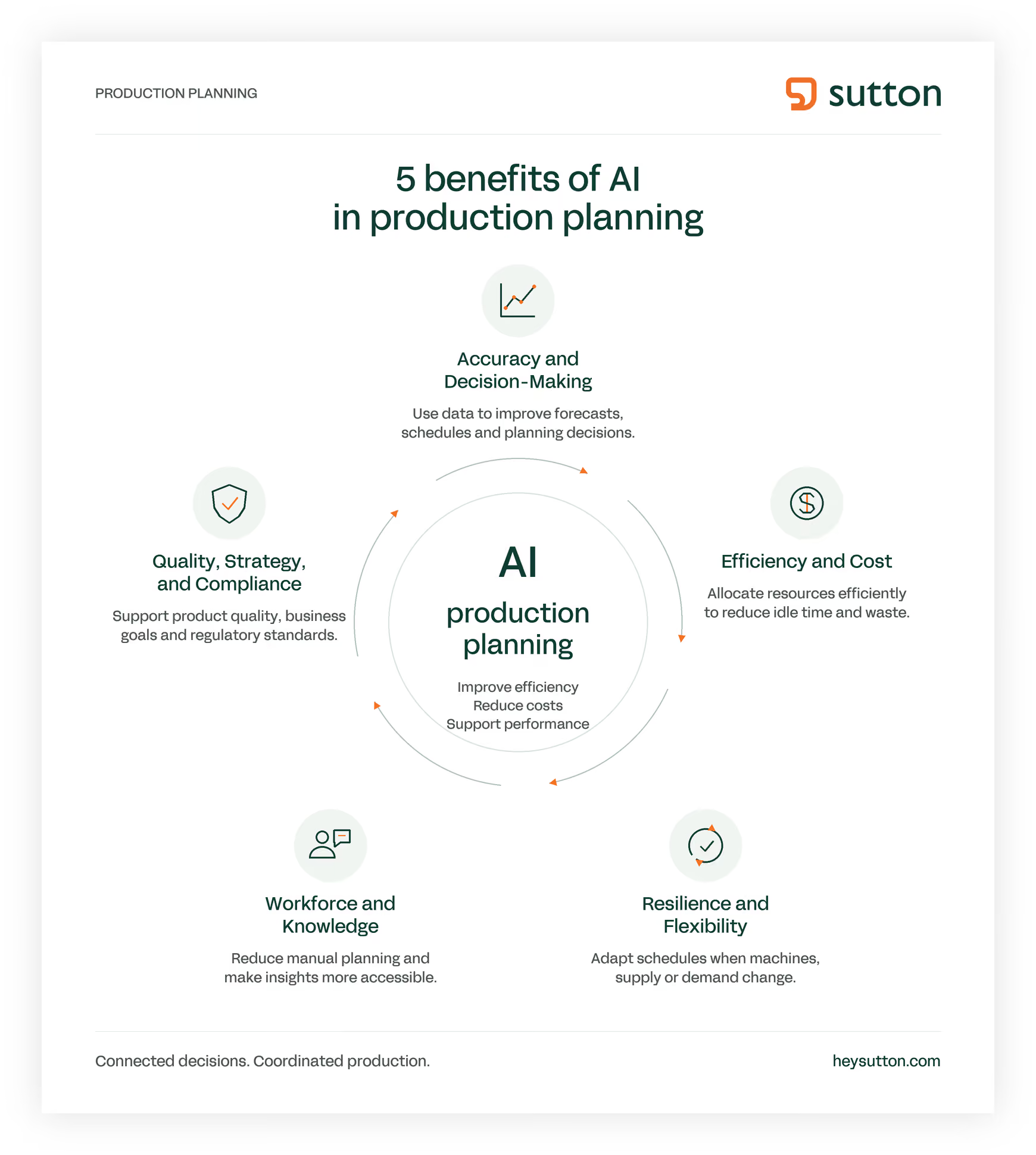
AI in production planning will be your full-time assistant that’s available 24/7 to help you:
- Improve efficiency
- Reduce costs
- Raise overall operational performance
Here are five benefits you can enjoy as soon as you adopt production planning AI in your business.
Accuracy and Decision-Making
AI analyzes large volumes of data with precision, which produces more accurate schedules and reduces overproduction, stockouts, and scheduling errors.
Historical data and predictive analytics also improve demand forecasting, so manufacturers can anticipate fluctuations and adjust schedules accordingly. Scenario analysis lets them explore what-if cases and see how different decisions affect production. Data-driven insights and recommendations on schedules and resource allocation support better decisions.
With modern interfaces and explainable models, planners can question a recommendation, adjust their assumptions, and apply their own judgment. AI then works as a collaborative advisor.
Efficiency and Cost
AI assesses the availability and capacity of machinery, labor, and materials and allocates them strategically.
This maximizes utilization and significantly reduces idle time. Streamlined processes and reduced downtime boost productivity, letting manufacturers produce more in less time. Optimized resource allocation, less waste, and better energy efficiency lower costs, and lower operating costs increase profitability. Optimized schedules that minimize lead times get products to customers faster, improving customer satisfaction and competitiveness.
Resilience and Flexibility
AI adapts schedules in real time when:
- Machines break down
- Supply chains are disrupted
- Demand changes
Production continues with minimal interruption instead of waiting for manual rescheduling, which improves reliability and on-time delivery.
Market needs have diversified, and only high-mix, low-volume production can meet them. Plans must therefore be revised each time needs change, and AI reduces the burden of those corrections while improving their accuracy. The same flexibility lets manufacturers accommodate product customization and meet specific customer requirements efficiently.
Accurate information sharing across departments also supports resilience. In processes managed in units of 0.1 seconds, delays in sharing information create significant waste. AI increases the amount of data that can be processed, which raises the value of real-time sharing.
Workforce and Knowledge
Production control often depends on the person in charge, and shortages of human resources across manufacturing add to that workload.
AI reduces the manual labor production managers must do and reduces dependence on individual skills.
AI planning copilots built on industrial-grade language models make production intelligence accessible to non-technical users. Planners and shop floor managers can query schedules, constraints, and trade-offs in natural language and receive transparent, explainable reasoning. This bridges skill gaps and speeds up decision-making.
Quality, Strategy, and Compliance
AI can oversee and regulate product quality at every stage of production.
As a result, products meet the desired standards, and rework and scrap decline. Strategically, AI-driven solutions help manufacturers align production schedules with broader business goals. Manufacturers that deliver faster, meet changing customer demands, and keep operations cost-effective gain a competitive edge. AI also reduces energy consumption and waste, which supports more sustainable manufacturing.
AI can verify that production schedules comply with industry-specific regulations and standards, which lowers the risk of compliance issues.
Implementing AI Production Planning and Scheduling with MCP
The Model Context Protocol (MCP) standardizes how AI agents securely access, contextualize, and manipulate shop floor data from ERP, MES, and IoT systems.
It works like a universal "USB-C port" for AI models. LLMs and multi-agent systems can discover and call tools across the enterprise without bespoke point-to-point API code. MCP servers also expose schemas and metadata for machine states, sensor telemetry, operator skill matrices, inventory levels, and quality thresholds, so agents reason accurately instead of hallucinating.
Manufacturing Operations Management (MOM) MCP architectures generate optimized schedules and tactical recommendations under bounded autonomy. They handle routine local repairs automatically and pause for human approval on strategic conflicts.
Step 1: Define Operational Objectives
Start by assessing the fragility of the current master production schedule and pinpointing chronic bottlenecks. Then set explicit KPIs, such as minimizing changeover times, reducing work-in-progress (WIP), or improving on-time delivery.
Step 2: Deploy Enterprise MCP Servers
Wrap existing data sources with MCP-compliant servers. These sources include:
- ERP systems
- MES
- SCADA
- IoT sensor streams
Expose standardized read and write endpoints for machine capacity and OEE status, workforce qualifications and shift availability, and inventory levels and active work orders.
Step 3: Integrate Scheduling Engines and Agents
Connect the agentic platform, such as Claude or a custom orchestrator running on Google Cloud and Vertex AI, to the deployed MCP servers.
Metaheuristics and digital twins are then available through the MCP tool interface. They run stochastic scheduling that stress-tests candidate schedules against disruption patterns and bottleneck forecasts.
Step 4: Pilot with Bounded Execution
Roll out the scheduler on a single production line or restricted cell first.
Enable agentic local repair, which shifts only affected jobs during minor anomalies, to eliminate schedule nervousness before scaling plant-wide. Supervisors review and authorize AI-suggested sequences through role-based scorecards and approval dashboards.
Here are some more steps to consider when piloting your new AI production planning project:
- Implementation Considerations — Agents must behave safely and stay reliable across manufacturing environments, which requires three controls.
- Permission models — Manufacturing MCP must honor the same permission structures that govern human users. Agents act only within the bounds of the invoking user's role. Sensitive actions, such as modifying records or triggering workflows, are limited to approved tools. Access is segmented by asset or line so it reflects physical production boundaries. These models prevent privilege escalation and ensure accountability.
- Validation and auditability — Tool definitions are versioned, and parameter schemas are validated before execution. Every agent action generates an audit-ready log. Enforce human-in-the-loop checkpoints for high-risk actions. This lets MCP pass the scrutiny of regulated processes and quality systems.
- Operational boundaries — Manufacturing MCP defines which non-destructive actions are allowed without review and which escalation rules apply to uncertain or multi-step operations. Tool-level constraints prevent dangerous combinations of actions, and fallback paths cover unexpected scenarios. These limits create predictable behavior and reinforce trust in the automation.
Connecting an AI Assistant to Live Production Data
Sutton, a production planning tool, connects to an AI assistant through an MCP connector.
The assistant can query:
- Real-time inventory levels
- Bills of materials
- Sales orders
- Purchase orders
It can also create or update sales and purchase orders. A planner can ask "What should I produce next week?" or "Which orders are most important today?"
The AI reviews live demand and inventory and suggests which Manufacturing Orders to prioritize. The planner then reviews and approves the plan, and Sutton creates and tracks production runs. Sutton also offers a Planning View for demand, capacity, and target dates for Manufacturing Orders.
Want to see Sutton in action for yourself? Feel free to book a demo with one of our AI production planning experts, who can give you a personalized tour of Sutton, so you can see firsthand how it can take your planning and operations to the next level.
.jpg)

