



Can You Use ChatGPT for Supply Chain Management?
Since we’re all using ChatGPT and other LLMs nowadays (even if we pretend we don’t), it’s only natural to wonder if you can repurpose something you’re already paying for to help you with your business, more specifically for supply chain management.
So, the answer to the big question is reduced to one word. Can you use ChatGPT for supply chain management:
Yes.
The honest long version answer, however, would be something more like:
Yes, but with the caveat that it can act as a digital assistant or partner, but it can’t operate without a human or access business systems on its own.
ChatGPT still controls most of the LLM market share and is used for tasks such as marketing content creation and data analysis to help managers make better business decisions. And now it’s starting to see more implementation in the supply chain field, since it’s a very useful tool for helping practitioners write:
- Write emails to customers and suppliers
- Create Standard Operating Procedures for staff
- Assist in creating ISO 9001-compliant documentation
Before ChatGPT and supply chain started becoming more popular, all of this would have been done manually, or, if software could help, it still required someone to edit and proofread. And although that’s still best practice, even when using AI to produce content, if your prompt is good and the context is clear, you could basically hand off the entire process to ChatGPT.
What ChatGPT Does Well in Supply Chain Work

Using ChatGPT to manage your supply chain works best when you treat it like your AI assistant.
You should be using ChatGPT to help you speed up the day-to-day repetitive tasks that would otherwise cost you and your team time and money every day to complete them. So, to get you started with ChatGPT and supply chain management, here are just some of the ways you can hand off certain tasks to it (just make sure that you’re still reviewing the output).
First-Draft Documents and Communication
Unless you have templated many of your documents and content-creation methods, creating everything from scratch every time is time-consuming.
And even if you are ahead of the curve and have already templatized as much as possible to save time when creating new documents and comms messaging, templates can only get you so far and have to be constantly renewed. What ChatGPT does instead is eliminate the pains of staring at a blank screen by giving you a fairly competent first draft of all different types of documents an operator needs to regularly create for supply chain management, including:
- RFPs
- Standard supplier questionnaires
- Policy guidelines
- Contract summary templates
- Summary templates
- Negotiation briefing templates
Research and Synthesis
First things first, as important as it is to read the latest reports or regulatory updates, reading the latest reports or regulatory updates is time-consuming, often requiring someone to sift through document after document to find a single relevant detail hidden in a 50,000-word report.
Or perhaps you’re trying to conduct some market research, and the person assigned to the job has just sent you a slide deck with 50 sheets. Although it’s all essential context to know when reading, ultimately there’ll only be a couple of lines that will be relevant for basically everyone at the company (the CEO wants to know the opportunity and the CFO wants to know the costs).
You and your team can use ChatGPT to summarize any important information to get breakdowns on things like:
- Market trends
- Vendor research
- Price comparisons
- Industry trends
- Stability of the global supply chain
The list above isn’t exhaustive, since the possibilities are nearly endless. As long as ChatGPT has access to the data source, you can get answers to any of your research questions.
Demand, Inventory, and Transportation Support
COVID-19 and recent geopolitical scandals have taught every supply chain manager a valuable lesson — be prepared for anything.
ChatGPT and supply chain management can be improved by using it for brainstorming different scenarios with you, so you always have a plan to mitigate potential risks. You can use it to test your current workflows and processes in the event of:
- Supply chain disruptions
- Port closures
- Seasonal demand shifts
Category Management and Supplier Relationships
When planning to buy a collection of similar products or services from different vendors, reaching a conclusion and getting stakeholder buy-in often takes weeks of research and analysis.
While you will always need stakeholder buy-in, ChatGPT can do the supply chain research and analysis in a couple of hours. You can prompt your assistant to be your seasoned procurement specialist, and feed it all the information you can find and ask it to outline a plan based on:
- The supply base
- Evaluation criteria
- Consolidation opportunities
- Implementation timelines
- Vendor risk assessments
Then once you have your vendors confirmed, you can repurpose ChatGPT to help you maintain an active relationship with them, with:
- Communication frameworks
- Performance feedback loops
- Collaborative-focused action plans
Contracts and Negotiation
Not all of us are well versed in the fine art of legalese — to the point that reading a contract can often be as hard as trying to understand a different language.
ChatGPT can help you and your operators clarify any wording that is unclear, doesn’t match your standards, or is missing clauses by clarifying terms related to:
- Payment terms
- Termination rights
- Auto-renewal periods
- Price caps
It’s not uncommon to negotiate contracts with your vendors, so ChatGPT can help you build a playbook your team can follow when entering these discussions, and it can even serve as a training ground to build negotiation confidence.
Sounds great, right? It is, but like we’ve been reinforcing throughout this article, there are nuances to how well ChatGPT can perform when using it for supply chain management.
The Hard Limits of General-Purpose ChatGPT
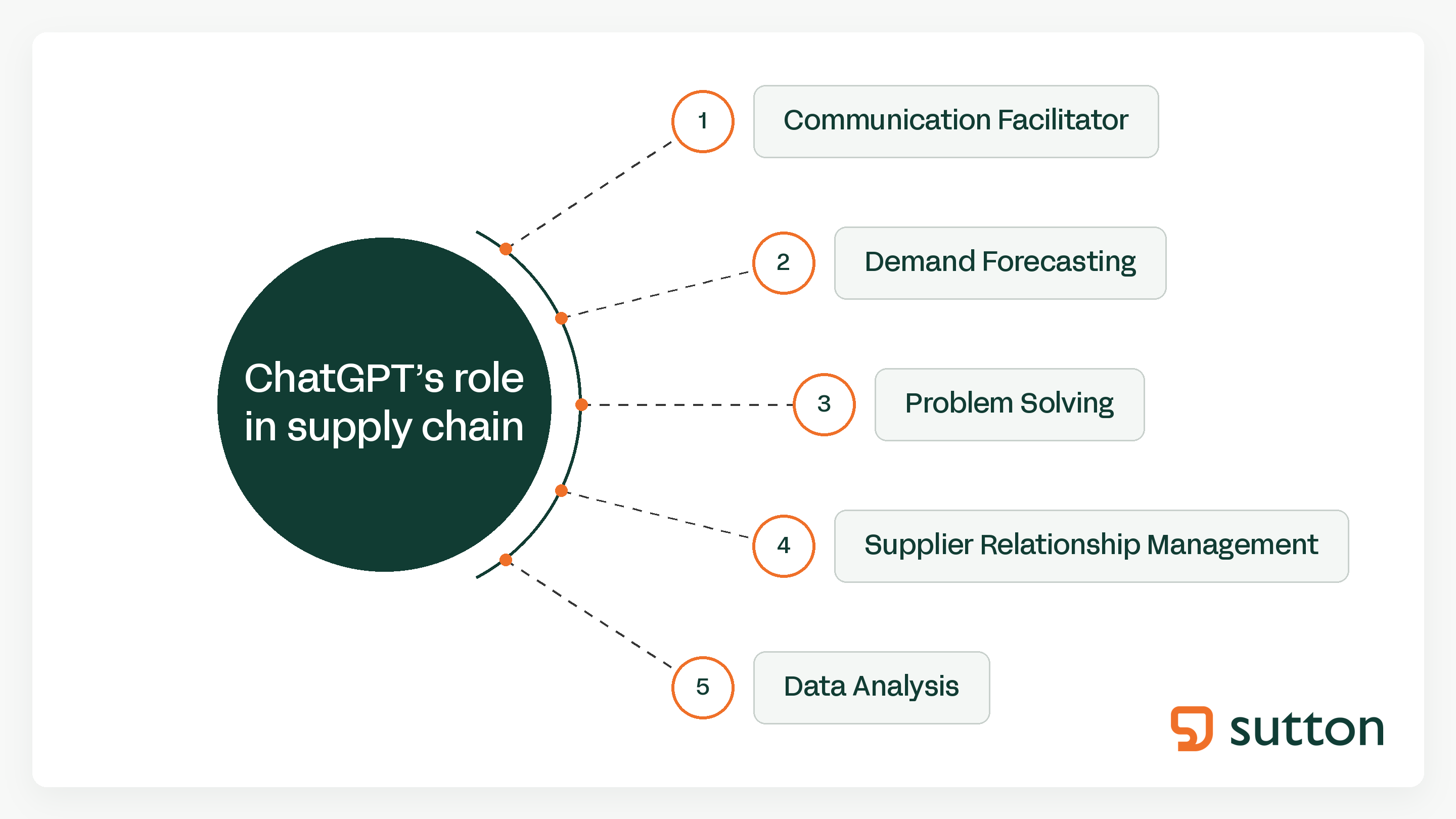
ChatGPT is a chatbot — and if you want to really boil it down, it’s one of the most complex predictive word calculators or generators to ever exist.
Although you can use it for your supply chain, its accuracy is limited, as is its use in day-to-day supply chain activities. So, be aware before you just start relying on it 100% as your pitch-perfect assistant.
Here are four limits to using ChatGPT for supply chain management.
No Direct Automation
Some AI supply chain assistants, like ChatGPT, aren’t able to perform any tasks directly within the manufacturing ERP solution your business is using.
With an MCP for manufacturing connection, it can retrieve certain information from your software and tools, but it can only suggest actions that should be performed, and can’t perform any actions itself like an AI agent or agentic AI.
Hallucinations and Reasoning Gaps
Using ChatGPT for supply chain work requires caution. In fact, the LLM will warn you about this before you even send a prompt. Its output is not always accurate and can make mistakes.
Another thing ChatGPT likes to do is produce information that sounds confident and potentially even plausible, but that is, in reality, something it completely made up because the algorithm has determined this is what the user wants to hear.
Another thing ChatGPT doesn’t do well is:
- Multi-step mathematical reasoning
- Complex logic puzzles
- Tracking state across long chains of thought
Whatever ChatGPT produces, you will need to validate it against real data or metrics, and sanity-check everything before sending out a potentially business-damaging document or making a decision based on the wrong information.
Context and Memory Limits
The web interface input box is typically capped at around 30,000 to 40,000 characters per message.
Long chats can lead to ChatGPT missing earlier instructions or turning "lazy." Uploaded PDF, DOCX, and TXT files also face strict page and file-size caps, beyond which the system stops processing details accurately.
And these context windows also vary by plan.
Since these plans tend to change (as do the context windows and memory limits) with every new model, your best bet for understanding what your current context and memory limits will be is to refer to the OpenAI Developer guides for the latest details.
Data Privacy and Compliance
Inputting proprietary pricing, supplier contracts, or confidential customer metrics into public AI models can expose company data.
Every prompt travels through OpenAI's servers. OpenAI supports opting out of data retention, but many organizations in finance, healthcare, and government still find that insufficient. Organizations have limited control over data residency, GDPR compliance, and the auditability of sensitive inputs and outputs.
How to Use ChatGPT for Supply Chain Safely Today
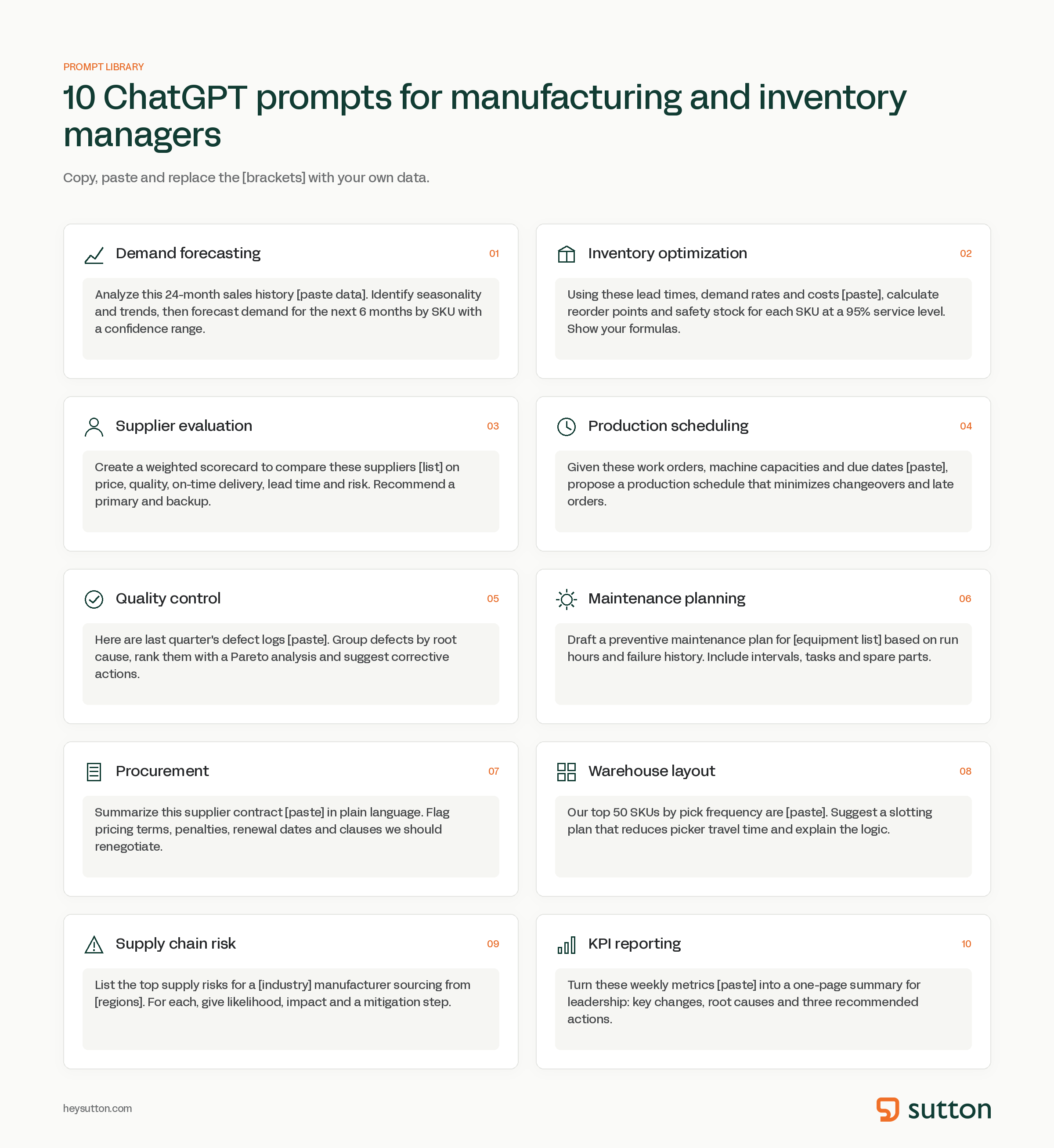
You can use ChatGPT safely for supply chain tasks by treating it as a virtual consultant or a brainstorming partner.
A few habits make the difference between generic output and usable output.
Give Context and Ask for a Format
A vague prompt like “help with inventory” gets a vague answer.
Try “We’re holding 45 days of safety stock, and lead times just jumped from 8 to 12 weeks. What should I be worried about?” State the format you want upfront, whether that is bullet points, a table, or a short summary. Treat the result as a first draft. Use it to organize ideas, then apply your own judgment.
Set Up Custom Instructions and Memory
Open your ChatGPT settings, find Custom Instructions, and enable them.
Define a role and your supply chain context in the fields provided. For example, you might set the role as a Chief Supply Chain Officer for an international automotive supplier that specializes in electric vehicle components. Then list the tasks, such as inventory management, supplier risk mitigation, demand forecasting, and sustainability practices.
Build the setup around the priorities a CSCO would hold.
These are inventory optimization, supplier relationships and risk, forecasting accuracy, sustainability and compliance, and cost reduction. Turn on the memory function as well. ChatGPT then remembers your preferences, past scenarios, and earlier decisions, so a question about geopolitical risk can build on last week’s supplier diversification discussion.
Force Clarifying Questions
Add a constraint to the prompt, such as “Ask me clarifying questions until you’re 95% confident you can complete this task successfully.”
A prompt like “I need to restructure our warehouse reorder points. Ask me clarifying questions about our lead times and safety stock first” puts that into practice.
Protect Your Data and Verify the Output
Never paste proprietary supplier contracts, real-time internal inventory figures, pricing structures, or customer lists into a public chat window.
Remove or anonymize company-specific figures before you run a prompt. Use ChatGPT to build risk-assessment matrices and Excel or Power BI formulas, and leave autonomous decision-making to your team. Cross-reference customs rules, tariff codes, import and export laws, and compliance updates through official government or regulatory portals.
ChatGPT Supply Chain Use Cases
Suppose a critical supplier in Country X faces food export restrictions because of political unrest.
Prompt ChatGPT as a CSCO at a global food and beverage company and ask for three immediate actions with practical implementation steps. A strong response covers three moves: review pre-qualified alternative suppliers, reallocate excess inventory to priority production sites, and brief customers, sales teams, and operations early.
Connecting AI to Your Supply Chain Data with Sutton

Sutton is a business operations platform that helps teams centralize and handle:
- Inventory management
- Order management
- Supply chain management
AI connects to your supply chain data in Sutton through an MCP (Model Context Protocol) connector. The connector allows an AI assistant to securely read and interact with your Sutton data in real time.
Once connected, the AI can query:
- Sales orders
- Purchase orders
- Quotes
- Line items
Supply chain ChatGPT can check inventory levels, lot information, and warehouse locations, and it can browse items and Bills of Materials. It can also create or update orders, items, and company records.
The main benefit is that your AI assistant works with your live Sutton data.
It answers questions about your orders, inventory, and metrics in real time. It generates daily summaries or priority lists from your actual data. It also helps build or troubleshoot API queries in plain language. All of this happens directly from the chat, which makes the AI assistant a practical part of your supply chain workflows.
Want to learn more about upgrading your supply chain with ChatGPT and Sutton? Feel free to book a personalized demo, where we’ll take you on a product tour with data relevant to your business workflows.