


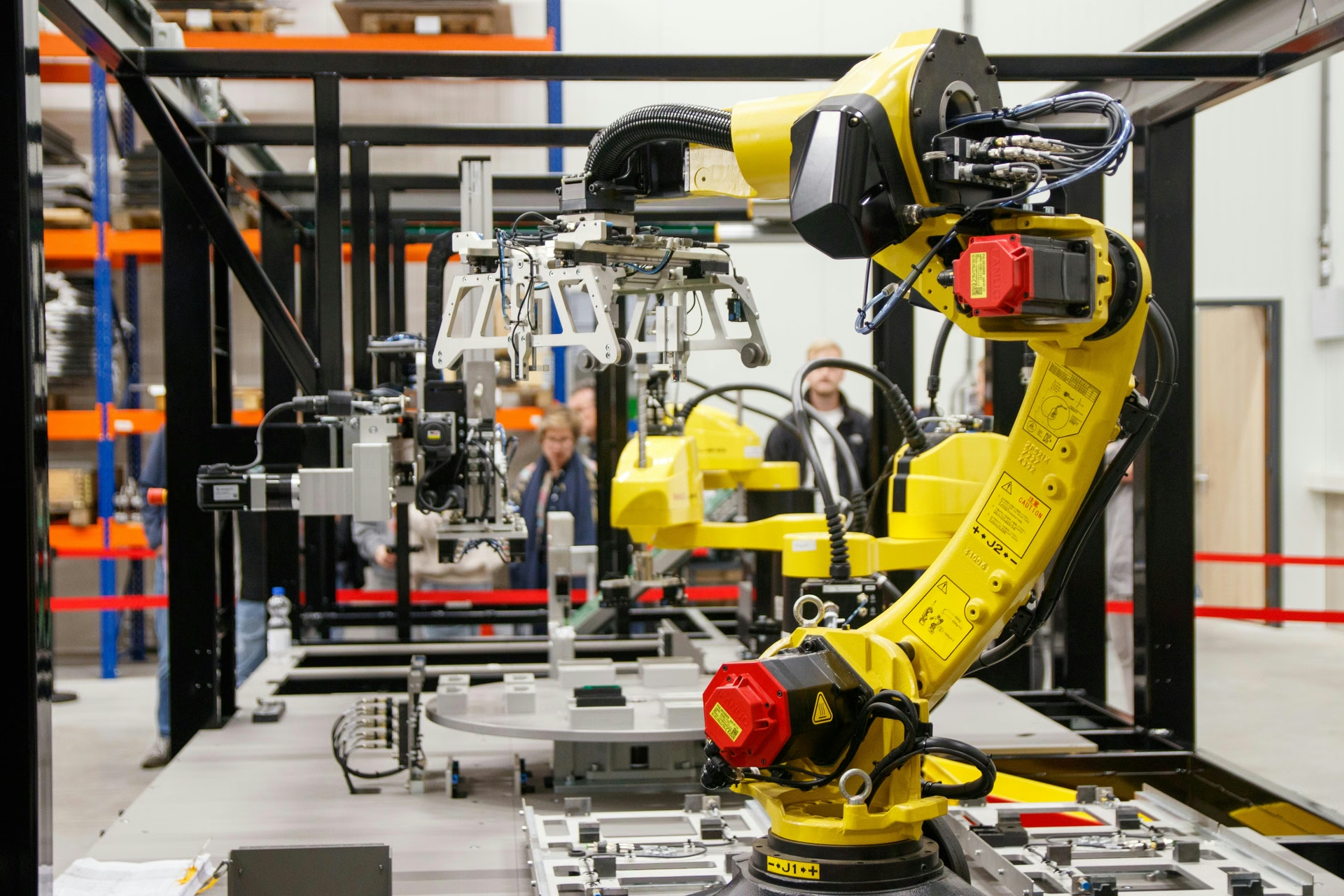
What is AI in manufacturing?
AI in manufacturing refers to the process of finding artificial intelligence technology and incorporating it into inventory, production, and supply chain operations to improve the efficiency of your operations.
Most AI tools aren’t built to replace software or machines (yet). Instead, the best use of AI in manufacturing is to integrate it with what you already have, with the goal of extracting data from your processes and using that data to either help detect patterns, spot problems, or even carry out fixes autonomously. How it collects and analyzes data depends on the AI’s application, but it usually collects data from sources such as:
- Sensor readings
- Equipment logs
- Production output
- Order histories
Even though AI seems to be the new frontier in tech, it still falls under Industry 4.0 (also known as smart manufacturing).
And the great thing about using AI in manufacturing is its seamless, ever-expanding applications in business. One practical, ship floor-related use case is for massive factories using IoT sensors and programmable logic controllers to collect data, they would need to always have at least one operator on standby with software to ensure that production is running smoothly. Now, with AI implemented, that job can be the sole responsibility of the AI, and depending on what tools you use, it may never require human intervention.
The 3 Main Types of AI Used in Manufacturing

The list of AI tools a manufacturer can use is endless, but the 3 main ones you’ll likely find in use within a factory each serve a different purpose, and deciding which ones to incorporate into your workflows depends on what problems you want to solve.
Do you want a tool that helps you with:
- Forecasting demand
- Creating something from scratch
- Finding problems and executing solutions
Let’s get to it.
1. Predictive AI
A predictive AI uses statistical models and machine learning to analyze historical data and, based on the information it is given, calculates the probability of future events (such as when seasonal sales might increase or decrease, or when a machine might break down).
By incorporating predictive AI into your production planning, you can replace the headache of manual predictions with a tool that can run these calculations in minutes.
2. Generative AI
Mostly used in creating content or building software, generative AI takes prompts or existing data you share with it to create things such as:
- Text
- Images
- Codes
Outside of building your own software or creating marketing materials, the best way to get the most ROI from generative AI in manufacturing is to use it for creating designs or summarizing documents, such as meeting minutes or product descriptions. Another great use of generative AI is knowledge retrieval: SOPs and FAQs from your staff can be added to the tool, and they can consult the AI to get answers to whatever they need to know.
3. Agentic AI
Finally, when we think of AI, we think of the Terminator and Skynet going rogue, and this is probably the closest thing that we have to that — agentic AI.
What agentic AI does is perpetually analyze data, and how it receives this data and what it analyzes is for you to decide. But with your parameters set up, agentic AI will then keep an eye on things, waiting for a discrepancy or an issue it's been trained to spot. And as soon as it sees that there is a problem, it automatically creates an action plan and assigns AI agents to address the problem — all without human intervention.
An example could be that it analyzes your inventory levels during a production run and generates a PO as soon as stock falls to a certain point, or maybe a customer changes their delivery address, and the agentic AI in manufacturing could even reroute their order so it goes to the right place.
And because of how powerful all these tools are, when it comes to AI in the manufacturing industry, you’re likely to see all 3 adopted into a business's workflows.
Why AI Adoption Is Accelerating Now
AI in manufacturing isn't a new phenomenon.
Ask any Gen-Z if you pry them away from the phone, or that old-school Fight Club office worker who’s been at the computer since 1999 — AI is everywhere.
So, it’s no surprise that you'll find that manufacturers are also starting to embrace this tech with the promises of:
- Falling costs
- Data that’s actually readable
- Tools that can operate themselves
In some cases, a manufacturer might not even realize they’re using AI in their workflows, as most modern manufacturing ERP software includes some form of AI, from analytics to basic chatbots. And with these AI integrations, it means that businesses can now organize their factory data, and collect even more information from their shop floor to improve their production efficiency.
Along with the rise of AI in manufacturing, there are also robots.
Now, automation, robotics, and AI scare a lot of people, as they ultimately threaten their jobs. But currently, the adoption of these technologies is an attempt to boost productivity, freeing skilled workers from performing repetitive tasks so they can focus on the jobs that bring the most value to the business and the customer.
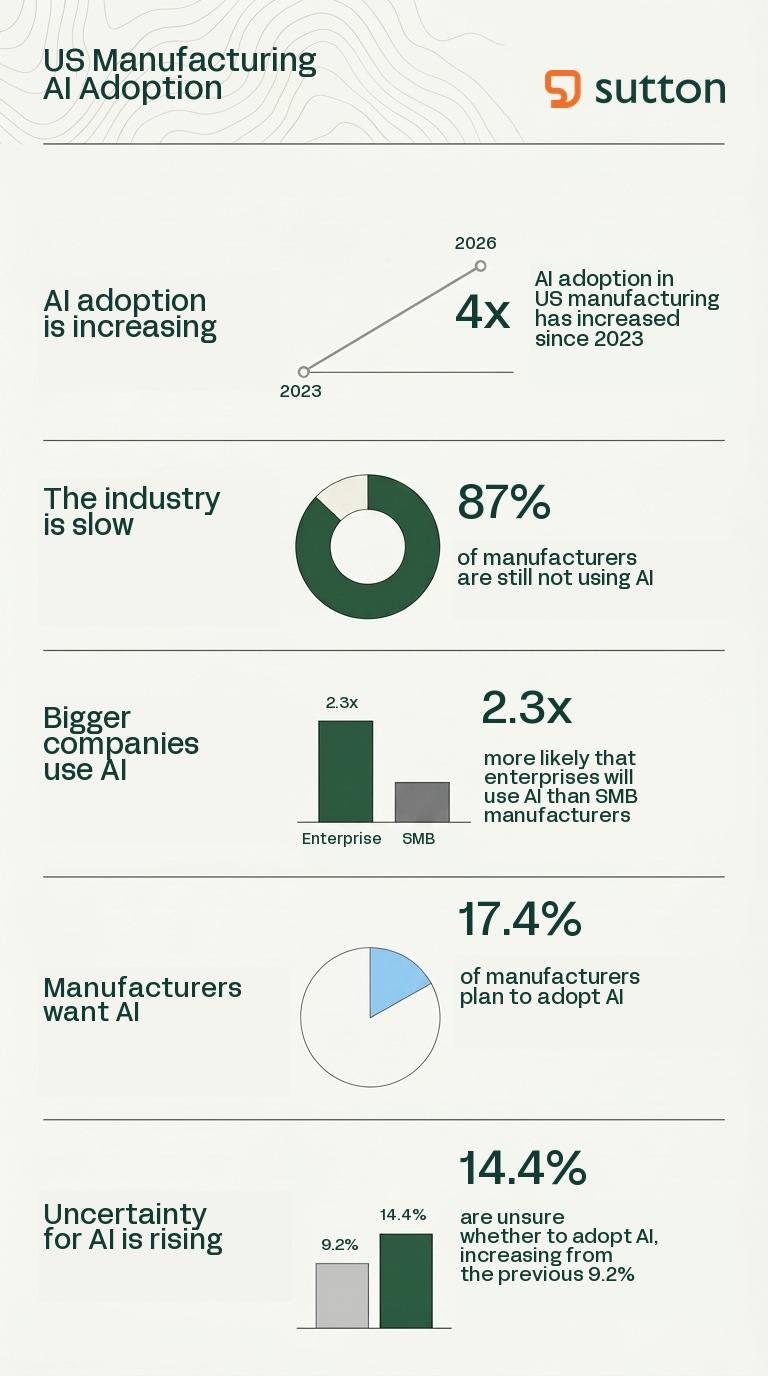
However, with all that said, we should mention that we researched the topic of AI adoption in the US, and even though tech companies have promised a big pot of gold at the end of the rainbow, the rate of adoption among manufacturers has been slow, and 87% of manufacturers still haven’t actually adopted AI yet.
Pro tip: Some manufacturing software lets you connect to your AI assistant. For example, Sutton has an MCP connector that integrates with your favorite AI tools, so you can ask questions and it’ll pull real-time data from Sutton and even execute tasks for you, such as creating sales orders, adding new items, or updating information.
The 5 Highest-Impact AI Use Cases in Manufacturing
Visual input: Assembly line with sensors visible on the machines.
So, now you know what tools are available when it comes to AI in manufacturing, and the opportunity that is out there, not only from adopting it, but also by getting ahead of your competitors.
The next step is to figure out what you want to do with it. As we’ve already mentioned, there are a bunch of ways you can use AI in manufacturing, it all depends on the problem you want to solve. But if you’re looking for a place to get started with it, here are 5 areas in which it can be implemented to achieve the most ROI.
- Demand forecasting and inventory optimization
- Predictive maintenance
- Quality control and defect detection
- Production scheduling and planning
- Natural-language access to operational data
1. Demand Forecasting and Inventory Optimization
Traditional demand planning relies on static spreadsheets and periodic reviews, so forecasts are often weeks out of date. AI replaces that with models that update every day, combining sales data with signals like weather and local events to sense demand shifts as they happen.
That capability shapes inventory management decisions too. Machine learning can set dynamic reorder points and trigger purchase orders automatically, and some systems run scenario simulations showing how a shortage or demand spike would ripple through production before it happens. On the warehouse side, computer vision and IoT sensors track physical stock in real time.
For manufacturers, better forecasting also shapes production itself:
- How much capacity to run
- When to scale a shift
- Where to invest in new lines
More accurate forecasting reduces the guesswork behind both overstock and stockouts, and automated replenishment keeps capital from sitting tied up in excess inventory — often the most measurable financial return a manufacturer sees from AI.
2. Predictive Maintenance
Traditional maintenance schedules are built around estimates, leading to two failure modes:
- Servicing equipment too early
- Missing a failure between checks
- Taking an unplanned halt
AI predictive maintenance replaces guesswork with data-driven insights into how a specific asset is performing.
It works by continuously analyzing sensor streams, catching micro-cracks or overheating weeks before they'd cause a breakdown. Sensor data includes:
- Vibration levels
- Thermal readings
- Acoustic signals
Some systems calculate Remaining Useful Life, shifting maintenance from a fixed calendar to actual asset condition, and at the fleet level, can time repairs around parts availability and production deadlines.
The payoff scales with data quality:
- Downtime reduced 35–50%
- Maintenance costs down 25–40%
- Equipment lifespan extended 20–40%
Manufacturers running mature programs also report a full return within 12 to 18 months.
3. Quality Control and Defect Detection
Manual inspection has a ceiling modern lines have outgrown — human inspectors work at limited speed and get fatigued across a shift. AI-driven computer vision addresses this by pairing cameras with deep learning to scan products in real time, catching flaws with a consistency no human shift can match, while also handling complex parts and precise dimensional checks.
What separates modern quality control from simple defect-spotting is root-cause analysis: by tracing a defect back to the sensor data from the machine that produced it, machine learning can flag a drifting setting before it produces thousands more bad parts. Sensor data includes:
- Temperature
- Pressure
- Speed
At scale, one manufacturer using AI-powered vision inspection achieved over 97% defect detection accuracy and cut inspection times by 60%. Beyond the immediate catch rate, this reduces rework and scrap and makes compliance easier to maintain.
4. Production Scheduling and Planning
A fixed schedule can't adjust on its own when reality diverges from the plan, whether that's a machine going down or a shipment running late.
AI-driven scheduling factors in machine availability, tooling, labor, and material supply together, generating an optimized sequence in minutes.
Digital twins extend this into "what-if" territory, letting a plant manager simulate a demand spike or rush order in a virtual environment before committing to a change on the floor. Reinforcement learning helps identify bottlenecks, grouping similar runs to cut changeover time and balance workloads.
Scheduling works best layered on the other AI manufacturing use cases here — tighter forecasts feed a more accurate master schedule, and maintenance data lets planners build in service windows ahead of time.
Manufacturers typically see 5% to 15% throughput improvement on constrained resources, plus fewer expediting scrambles and more consistent on-time delivery.
5. Natural-Language Access to Operational Data
Manufacturing systems generate enormous amounts of data, but most of it sits locked inside MES, SCADA, and legacy databases, requiring specialized knowledge to query. When a line slows unexpectedly, the person who needs the answer fastest is often least equipped to find it.
Natural-language interfaces close that gap. A supervisor can ask "Why did line 3 slow down today?" and the system translates that into the database commands needed, returning a clear summary. This speeds troubleshooting from minutes to seconds, lowers the bar for new hires, and reduces the silos that keep production, maintenance, and quality teams working off separate pictures of the floor.
Where Small and Mid-Size Manufacturers Should Start
These use cases aren't reserved for companies with enterprise budgets. Cloud-based tools have removed most of the infrastructure barriers, and mid-size manufacturers have a speed advantage, since, without layers of approval to work through, a focused pilot can go from idea to results in weeks.
The right starting point is wherever you already have usable data and low risk of a misstep — usually predictive maintenance or visual quality inspection. Predictive maintenance can begin small, by putting sensors on your most critical machines to flag issues before they become stoppages. Visual inspection follows the same logic, starting with smart cameras trained on good and bad parts on one line.
The path from idea to pilot is consistent:
- Identify one pain point costing you the most time or money
- Audit your data — check what your machines, PLCs, and ERP already capture. Clean data matters more than a large archive
- Run a contained pilot on one machine or line for three to six months, with clear metrics defined up front
- Choose off-the-shelf software that plugs into existing systems rather than a custom build
- Bring your team in early — operators who trust the tool are often what determines whether a pilot sticks
Use the results from that first pilot to build the case and budget for the next one.
The Common Barriers to AI Adoption
We’ve already touched on one big one, and that’s the fear of AI.
And it’s a perfectly logical fear to have. All your staff see is you implementing something cheaper and potentially quicker than a human, while asking them to train their own replacement.
This is just one hurdle to overcome when implementing artificial intelligence in manufacturing. Others include:
Legacy Machinery and Fragmented Data
Most floors run decades-old PLCs and proprietary protocols alongside newer systems that don't share a data format, and older equipment often has no sensors at all. Retrofitting kits can add IoT sensors without replacing equipment, and edge gateways can translate old protocols into formats modern tools can read. Start with one high-priority data stream on one line rather than integrating everything at once.
Workforce Skills Gap and Floor-Level Resistance
Manufacturing has hired for process skills rather than data science, and operators often see a new AI tool as a threat rather than a help.
Training programs that pair existing staff with external specialists close the technical gap faster than hiring from scratch. On trust, a predictive maintenance system that flags a failing bearing spares the maintenance team an emergency repair they already dread — workers who see AI eliminating a problem they hate tend to become advocates.
Proving ROI
Vague metrics and underestimated integration costs make it hard to justify spending, especially for smaller manufacturers.
Treat the pilot like any capital project:
- Pick one measurable metric
- Establish a baseline
- Run a contained test against it
Regulatory and Safety Standards
Deploying AI into an active line raises the stakes, since a flawed model can affect physical output. Testing in a simulated digital twin environment first lets manufacturers validate accuracy and safety before touching a live line.
How Connected Manufacturing Software Makes AI Practical

Every use case above depends on a software layer that can pull data out of machines and sensors and put it somewhere AI can use it.
Connected manufacturing software solves the fragmentation problem by unifying those silos into a single context — which is also where much of the time saved comes from.
That same platform enables real-time AI by feeding live data straight to the AI models watching for it, replacing the lag of a manager reviewing yesterday's report, so the response happens while there's still time to act.
This software also manages risk because programmable logic controllers act as a hard boundary, meaning AI never gets unsupervised control over physical machinery. A model can recommend stopping a machine for maintenance, but a human technician carries out the physical step. That human-in-the-loop design lets manufacturers deploy AI with confidence, without treating every output as a leap of faith.
Digital twins extend this foresight further, simulating a schedule change across the full plant before it touches the floor — catching cases where fixing one bottleneck would starve another line of materials.
None of the five high-impact AI use cases in this guide work in isolation. Connected software is what turns them from separate pilot projects into a single operating system for the plant.
AI in Manufacturing and Sutton

Sutton is an ERP platform that manages manufacturing data like sales orders, inventory, and production.
Its MCP connector lets an AI assistant read and act on that data directly, connecting to whatever chat-based assistant you already use day-to-day.
Through this connection, you can ask about open sales orders, check inventory levels, browse the item catalog, or ask broader questions, such as what needs attention today, and get answers grounded in live Sutton data rather than a static export. The connection runs both ways, so the assistant can also create sales orders, add new items, or update existing records — letting you act on what you find without switching over to Digit itself.
If you would like to see Sutton in action or ask us any questions about getting it up and running alongside your AI in manufacturing operations, then feel free to book a call, and we can give you a personalized demonstration.